
August 14, 2026
Why Updated Medical Records May Matter for Chronic Medication Refills Online

📌 Key Takeaways
The author recommends sharing current, accurate records so clinicians can judge whether a chronic medication refill remains appropriate.
-
Current Health Comes First: Clinicians need today’s medication use, health changes, and uncertainties, even when the prescription itself has stayed the same.
-
Separate Facts From Gaps: The author recommends marking details as confirmed, changed, conflicting, missing, or unsure instead of guessing.
-
Report Every Change: The author recommends reporting changed doses, medications, diagnoses, allergies, symptoms, side effects, tests, and monitoring.
-
Prepare, Don’t Promise: Accurate records may reduce follow-up questions, but they cannot guarantee approval or replace a clinician’s judgment.
-
Know Service Limits: Refill Genie reviews eligible existing medicines, not new treatments, acute conditions, controlled substances, or every drug.
Current facts beat old records and confident guesses.
Adults seeking online chronic medication refills will build clearer requests using the practical checklist that follows.
You already know the medication. You have taken it for months or years, and the routine feels familiar. But when a licensed clinician reviews an online refill request, familiarity alone is not enough — the reviewer needs information that reflects your situation right now, not the situation captured on an old label or a portal entry from a previous prescriber.
This pressure makes it tempting to submit whatever is easiest or leave out minor changes. Take the time to prepare accurate records. Current, accurate information helps a clinician understand whether a refill request still matches your present medication use and health context. Below, you will find a practical checklist for organizing that information and a clear explanation of what a responsible review may involve. Whether you are between providers, waiting on a new appointment, or simply running low, preparation is the most useful step you can take right now — even when time feels short.
Why “Current” Matters in an Online Refill Review
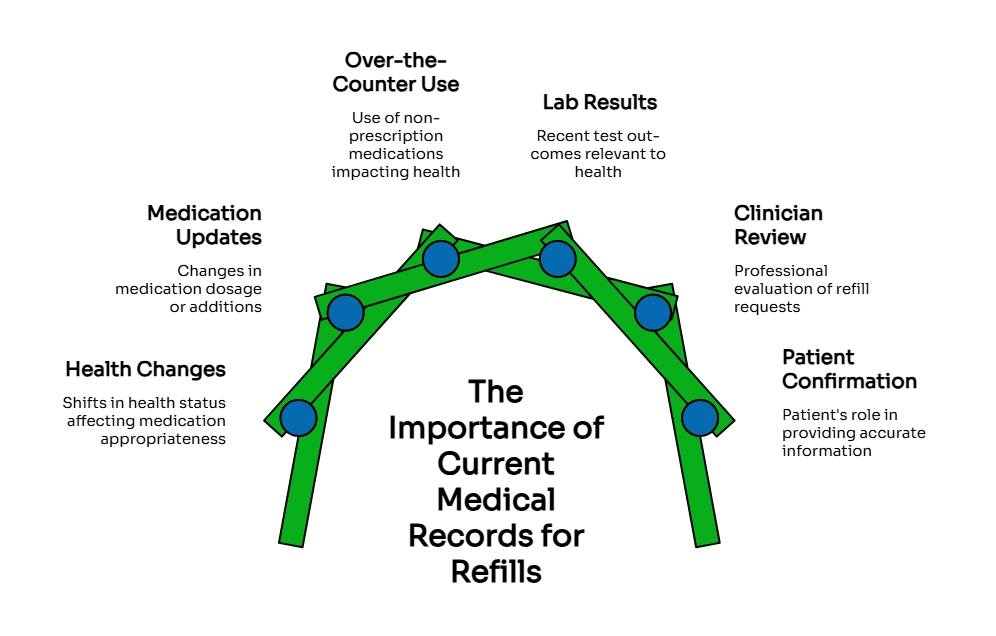
A prescription written six months or a year ago confirmed that a particular medication, strength, and schedule were appropriate at that time. Since then, your health may have shifted in ways that affect the clinician’s assessment — a new diagnosis, a different dose, added medications, or side effects you have not yet discussed with a provider.
Even if the medication itself has not changed, the clinician reviewing your request may still need confirmation that your broader health context remains current. A stable prescription does not always mean a stable health picture, and details that seem minor to you — a new over-the-counter medication, a recent lab result, a subtle change in how you feel — can be relevant to whether a refill is still appropriate.
You may reasonably think, “My medication has not changed, so why aren’t my old records enough?” An older record can document history, but it cannot confirm your current medication use or broader health information. If nothing has changed, say that clearly rather than assuming the old document communicates it for you.
When a clinician reviews a refill request, the information you provide is often the primary window into your present medication use. Paperwork does not make the decision — it gives the reviewer the details you can confirm, along with any conflicts or gaps that still need clarification. Outdated or incomplete details do not automatically disqualify a request, but they can lead to follow-up questions or a recommendation for additional evaluation before a refill can be considered.
Incomplete records do not make you careless. Do not assume they automatically disqualify a request. Identify the source, disclose uncertainty, and let the licensed professional evaluate the information. Accurate limits are more useful than confident guesses.
Information Worth Updating Before You Request a Refill
Think of preparation in four categories. You do not need a perfect medical file. You need an honest, organized snapshot of what you know, what has changed, and where gaps exist.
Your existing medication details. Start with the basics: the exact medication name, strength, form, and current directions. If you still have a recent prescription bottle or pharmacy label, that is a useful reference. Transcribe the information exactly as it appears rather than rewriting or interpreting it. Note that the label may not reflect a recent adjustment — a point worth flagging rather than ignoring.
Your care history. Identify the prescriber who last managed this medication and the pharmacy that most recently filled it. If you have access to a patient portal, prior prescription records, or discharge paperwork, gather what is readily available. Attach a source to each fact when possible — a short note such as “current label,” “older portal entry,” “pharmacy record,” or “from memory” separates documented details from information that still needs confirmation. Exact dates help, but an honest approximation is better than a guess presented as fact.
Changes since your last prescription. Patients overlook this category most often. If your dose or schedule changed, you started or stopped another medication, you received a new diagnosis, or you experienced symptoms, side effects, or new allergies that were not present before, those details matter — even if they seem unrelated to the medication you are refilling. A clinician is better positioned than you are to judge whether a change is relevant, so disclose fully and let the reviewer assess. Monitoring involves follow-up tests or information a clinician requests, rather than data you interpret yourself. For a closer look at how dose or schedule changes can affect a refill request, see this guide on what to check after a dose or schedule change.
Questions and uncertainty. If your bottle says one thing and you remember a different instruction, write down both versions. If records are missing or you are unsure about a date, strength, or prior provider, note that uncertainty rather than filling the gap with a guess. These are questions for the reviewing clinician, not problems you need to solve on your own.
A caregiver may help collect records, but should preserve the patient’s account and avoid making clinical choices on the patient’s behalf.
For more detail on what to compile, see this resource on records to gather before an online refill.
A Quick Way to Sort What You Have
Before using the checklist, it can help to assess the status of your information at a glance:
| Confirmed and current | Changed or conflicting | Missing or unsure |
|---|---|---|
| Medication name and strength match your current use | Bottle label shows a different schedule than what you recall being told | Cannot locate the prior prescriber’s name or contact information |
This kind of sorting helps you see where your records are solid, where something needs to be flagged for the clinician, and where a gap exists that you should disclose rather than guess about.
Updated Refill Review Readiness Checklist
Use this checklist as preparation guidance — not as a universal requirement list. Different providers and medications may call for different details. Complete it in one place before starting an intake form, and keep any supporting material accessible in case the reviewer asks for it. Mark each line as confirmed, changed or conflicting, or missing or unsure — every line should have a status, even when that status is “missing” or “unsure.”
Existing medication details
-
Exact medication name, strength, and form from the most current source available
-
Current directions exactly as provided to you (dose, frequency, timing)
-
A photo or copy of the most recent prescription label, if available
Care history
-
Name of the prescriber who last managed this medication
-
Pharmacy name and contact information
-
Last known refill or prescription date, if accessible
Changes to disclose
-
Any dose or schedule changes since the prior prescription
-
New medications started or stopped, and any newly reported allergies
-
New diagnoses, symptoms, side effects, tests, bloodwork, or other monitoring information
Questions and uncertainty
-
Conflicting instructions between label, portal, and memory — noted for the clinician
-
Missing records, unresolved questions, or concerns to raise during review
The goal is not a perfect file. It is an honest separation between what you can verify, what changed, and what still needs a question.
If you manage multiple chronic prescriptions, a system for keeping refill information organized can make future requests smoother.
What if Your Dose, Schedule, Symptoms, or Side Effects Changed?
Changes are not disqualifying — but they are worth disclosing accurately. State what changed, when you noticed it if you know, and where the newer information came from. If the date or source is uncertain, say that plainly. Do not omit a change because it seems unrelated; describing it is disclosure, not interpretation. Do not start, stop, skip, double, restart, or change a dose based on an article — leave treatment decisions to the licensed professional reviewing your request. If an intake form has limited space, note the change briefly and ask how to provide more detail.
If any symptom feels severe or potentially dangerous, seek appropriate urgent or emergency medical care rather than waiting for an online review.
Possible Outcomes of a Responsible Refill Review
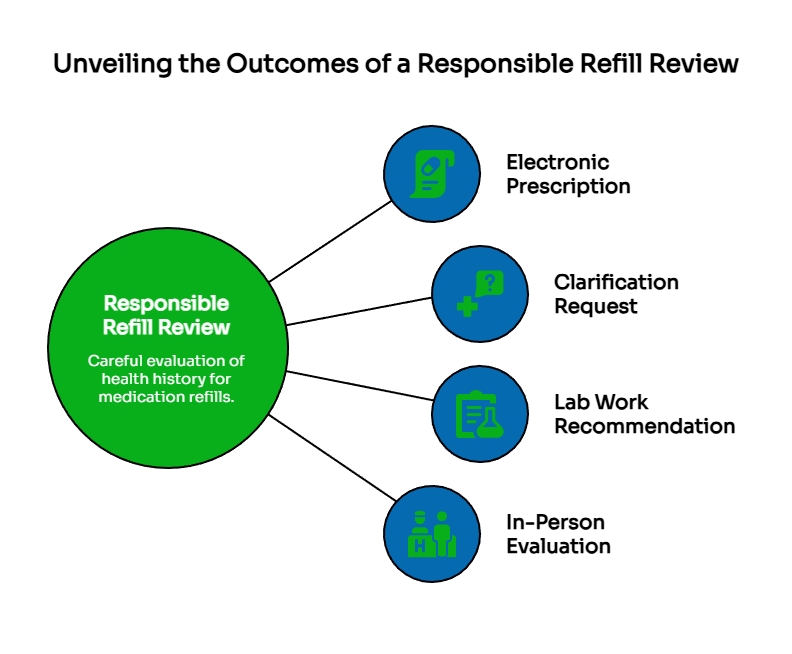
Submitting accurate information does not guarantee a specific result. According to Refill Genie’s online prescription refill process, the service asks basic health-history questions, has a clinician review the submitted information, communicates by text, and may send an electronic prescription for an existing medication to the selected pharmacy if appropriate. A responsible review may lead to several outcomes:
The clinician may determine that the refill appears appropriate and send an electronic prescription to your pharmacy. The clinician may request clarification or additional information before making a decision. In some cases, the clinician may recommend lab work or monitoring before a refill can be considered — according to Refill Genie’s current service information, bloodwork may sometimes be requested, and when it is, the lab order and interpretation are provided at no extra charge. The clinician may also recommend in-person evaluation or a different care pathway if the request falls outside the boundaries of what online refill review can safely address.
Each of these is a normal, responsible outcome. A request for clarification is not a rejection — it is part of a careful review. The more accurately you have documented your current situation upfront, the fewer follow-up questions you may need to address.
Know the Boundaries of Online Refill Care
Online refill services are designed for existing medications, not for starting new treatments or diagnosing new conditions. Understanding these boundaries helps you set realistic expectations:
Refill Genie states that it does not diagnose acute conditions or start new medications. The service covers refills of existing prescriptions when a clinician determines it is appropriate. According to Refill Genie, certain medications are excluded, including controlled substances and medications that require close monitoring of blood levels. Refill Genie describes itself as a temporary bridge for gaps in care — not a replacement for a primary care provider who can perform regular exams and manage your health over the long term. Approval is never guaranteed, regardless of how complete your records are — clinician judgment and medication suitability always apply. U.S. readers should check current provider requirements and local availability rather than assuming access is the same in every state.
For a deeper look at what may or may not qualify, see this overview of online refill eligibility when a chronic condition is stable. For a broader understanding of how the process works, you can review Refill Genie’s online prescription refill process.
Frequently Asked Questions
How recent do my medical records need to be for an online refill?
There is no single age cutoff that applies to every medication or every provider. Requirements can depend on the medication, the prescribing history, and the individual circumstances. Check the specific provider’s requirements and be prepared to share the most current information you have — along with honest notes about anything you could not locate or confirm.
What if my prescription label does not match my current dose or schedule?
Document both versions — what the label says and what you recall — and disclose the discrepancy to the reviewing clinician. Do not decide on your own which set of instructions to follow. A licensed healthcare professional can help determine the correct course.
Do updated records guarantee that my refill will be approved?
No. Accurate records support a thorough review, but they do not determine the outcome. Clinician judgment, medication suitability, monitoring needs, and service boundaries all factor into the decision.
What if I have new symptoms or side effects?
Disclose them accurately during the review process. A licensed clinician can help evaluate whether a symptom is relevant to your medication or health situation. If any symptom feels severe or life-threatening, seek emergency medical care immediately rather than waiting for an online review.
Prepare Now, Ask Questions Later
Gathering your medical history does more than speed up paperwork; it actively protects your health by removing guesswork from the equation. Taking ten minutes to consolidate these details ensures that when a clinician reviews your file, they are treating the person you are today, not the patient you were six months ago.
Review your current medication information and prepare questions for a licensed healthcare professional. If you are exploring online refill options for an existing medication, you can learn more about Refill Genie’s online prescription refill process.
Disclaimer: This article is for general informational purposes only and does not constitute medical advice, diagnosis, or treatment. Readers should consult a licensed healthcare professional for questions about their individual health, medications, or care decisions. Information about Refill Genie’s services reflects the company’s published descriptions at the time of writing and may change.
Our Editorial Process:
Our expert team uses AI tools to help organize and structure our initial drafts. Every piece is then extensively rewritten, fact-checked, and enriched with first-hand insights and experiences by expert humans on our Insights Team to ensure accuracy and clarity.
By: The Refill Genie Insights Team
The Refill Genie Insights Team is our dedicated engine for synthesizing complex topics into clear, helpful guides. While our content is thoroughly reviewed for clarity and accuracy, it is for informational purposes and should not replace professional advice.