
September 25, 2026
What to Ask Before Choosing an Online Prescription Refill Service for Maintenance Medications

📌 Key Takeaways
The author recommends comparing clear answers about refill services before trusting promises of speed or sharing personal health information.
-
Eligibility Depends on Your Situation: Your medication, current health, and location can affect whether a service can consider your refill request.
-
Approval Is Not Automatic: A licensed healthcare professional reviews each request and may ask questions before deciding whether to approve it.
-
Privacy Needs Clear Answers: The author recommends checking how services collect, share, and handle health information before submitting personal details.
-
Declined Requests Need Next Steps: Clear services explain how they handle declined requests and whether they offer guidance about other care options.
-
Temporary Refills Have Limits: Bridge care helps cover temporary gaps in prescriptions but does not replace ongoing care from your regular provider.
Clear answers matter more than promises of speed.
Adults taking regular maintenance medications will find questions to compare refill services in the nine-question checklist below.
An online prescription refill can look straightforward: fill out a form, answer a few questions, pick up the medication at your pharmacy. When you are juggling a full schedule and your current prescriber is unavailable, that simplicity is appealing.
Convenience alone, however, does not tell you whether the service fits your specific refill situation. A few terms are worth clarifying before you start comparing. A maintenance medication is a prescription you take on an ongoing, regular schedule to manage a stable condition. An existing prescription refers to a medication that has already been prescribed to you by a licensed provider. A refill request is a submission asking a service to renew that existing prescription — it begins an evaluation, not an automatic approval. Clinician review means a licensed healthcare professional evaluates your request individually rather than processing it automatically. Bridge care refers to a temporary refill service designed to cover a gap until you can reconnect with your regular prescriber.
Online refill services differ in how they handle clinician review, what eligibility boundaries they publish, how much medical information they collect, how they explain privacy practices, and what happens when a request cannot be approved. Those differences matter before you share health information or commit your time.
The nine questions below give you a reusable framework for evaluating any service. Use them to compare answers, spot missing information, and decide whether the process is transparent enough to proceed.
Nine Questions to Ask Before You Submit a Refill Request
| Question | What a clear answer should explain |
|---|---|
| 1. Is the service designed for existing prescriptions? | Whether it handles refills of current maintenance medications and whether it starts new treatment |
| 2. Who reviews the request? | The type of licensed clinician involved, how the review is conducted, and whether licensing can be verified for your location |
| 3. What information will be required? | Specific medication, health, identity, and pharmacy details you should prepare |
| 4. How does the service determine eligibility? | Published criteria, limitations, and any medications or situations it does not cover |
| 5. How are privacy and data handling explained? | Where to find the privacy policy, what information is collected, who can access it, and how communication works |
| 6. How and when can the clinician ask follow-up questions? | The communication channel, expected timing, and how clarifications are handled |
| 7. What happens if the request cannot be approved? | Whether the service explains possible outcomes, provides guidance on next steps, or recommends a different care pathway |
| 8. Does the service explain its role in ongoing care? | Whether it positions itself as a temporary resource or a long-term replacement for primary care |
| 9. Is the service currently available in your state? | How to verify availability before investing time in the process |
Each section below unpacks the questions that carry the most weight in your evaluation.
Start by Checking Whether the Service Fits the Refill Situation
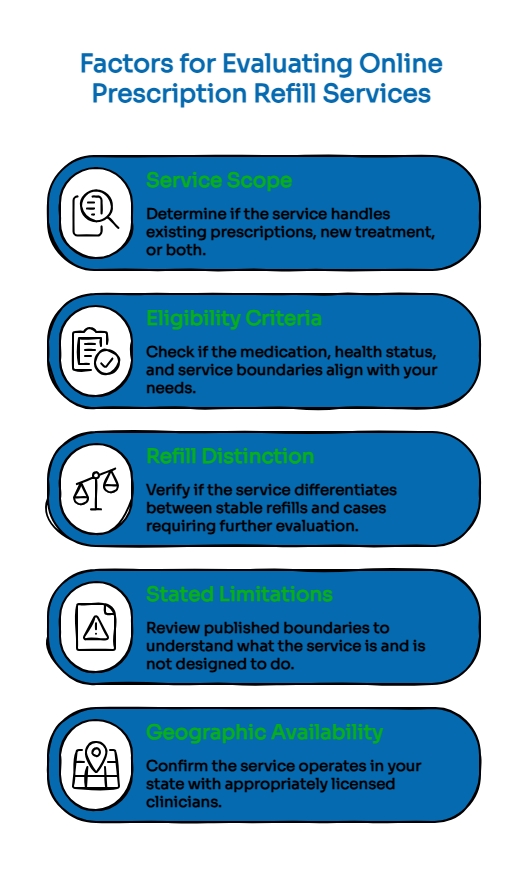
The first filter is scope. A responsible service should clearly state whether it handles existing prescriptions, new treatment, or both. If you already take a maintenance medication and simply need continued access, look for a service built around that specific situation.
A long history with a medication does not automatically mean it qualifies. Eligibility can depend on the medication itself, your current health status, and the service’s published boundaries. Look for a service that explains its limitations before collecting payment or medical information. Transparent boundaries are a trust signal, not an inconvenience.
Ask whether the service distinguishes between a stable refill and a situation that may require more evaluation. A new symptom, a recent dose adjustment, or an incomplete medication history can move a request outside the scope of a straightforward refill. You can explore what makes a maintenance medication eligible for an online refill for a closer look at how eligibility works in practice.
RefillGenie, for example, states that its refill process concerns existing medicines and does not diagnose acute conditions or start new medications. It also describes itself as bridge care rather than a replacement for an ongoing relationship with a primary care clinician. That kind of stated limitation helps you understand what the service is (and is not) designed to do.
Availability deserves a separate check. A service may market itself broadly while operating only where appropriately licensed clinicians are currently available. Confirm coverage for your state through the service’s current information before investing time in the intake process.
Ask What Responsible Clinician Review Actually Involves
Submitting a refill request is not the same as being approved. A responsible service should make the review process visible: who evaluates the information, what qualifications they hold, and how follow-up works if something needs clarification.
Ask whether a licensed clinician reviews your health history, current medication details, allergies, and any recent changes. A service that collects only a medication name and a payment method, without asking about your broader health picture, may not be conducting the kind of individualized review that an existing-prescription refill can require.
Follow-up questions from the reviewing clinician are not a sign of a problem. They can indicate that the service is verifying details rather than processing requests automatically. For instance, a hypothetical busy professional whose prescription label shows one set of directions while their current dosing schedule has changed should expect clarification, not instant approval. If your label, current instructions, or health records contain conflicting information, disclose the difference rather than selecting one version without explanation — the clinician can then determine what additional review is needed.
Ask how the service handles inconsistent or incomplete information. A responsible answer involves additional questions or a recommendation for a different care pathway, not a workaround. You can read more about signs a refill request may need additional review to understand what factors can make a routine request less straightforward.
Ask What Information, Communication, and Privacy Protections to Expect
A substantive review requires substantive information. Depending on the service, you may need to provide your current medication name, strength, and directions; prescriber details; pharmacy contact information; relevant health history; current allergies; recent changes; and identity verification.
Exact requirements vary, so confirm what the specific service requests. A short preparation checklist can help:
-
Current prescription label (or a clear record of medication name, strength, and directions)
-
Prescriber name and contact information
-
Pharmacy name, location, and phone number
-
A list of current allergies and other medications
-
Any recent health changes or new symptoms relevant to the refill
Ask how your identity will be verified — not merely which identifying details the form collects, but how the service confirms that you are who you say you are. That distinction matters when you are sharing personal health information through an online process.
A separate guide covers health information that may be needed for refill review in more detail.
Communication matters as well. Ask which channel the service uses (text, secure messaging, phone, or another method), how follow-up questions are handled, how you will recognize a legitimate message from the service, and whether you will receive confirmation when the review is complete.
Privacy deserves its own set of questions. A badge or a general statement that the service is “secure” should not end your evaluation. Ask where the full privacy policy is published, what categories of information are collected, who can access the data, how you can submit questions or request corrections to your information, how you can raise a privacy concern, and what happens to your data if the request does not proceed. If you cannot locate clear answers, that gap is worth noting before you submit personal health details. Specific privacy and data-protection requirements can depend on the type of organization and how it handles health information, so reviewing the service’s own explanation is an important step. For a broader look at trust indicators, you can also review how to evaluate online refill safety.
Ask What Happens When a Refill Cannot Be Approved Online
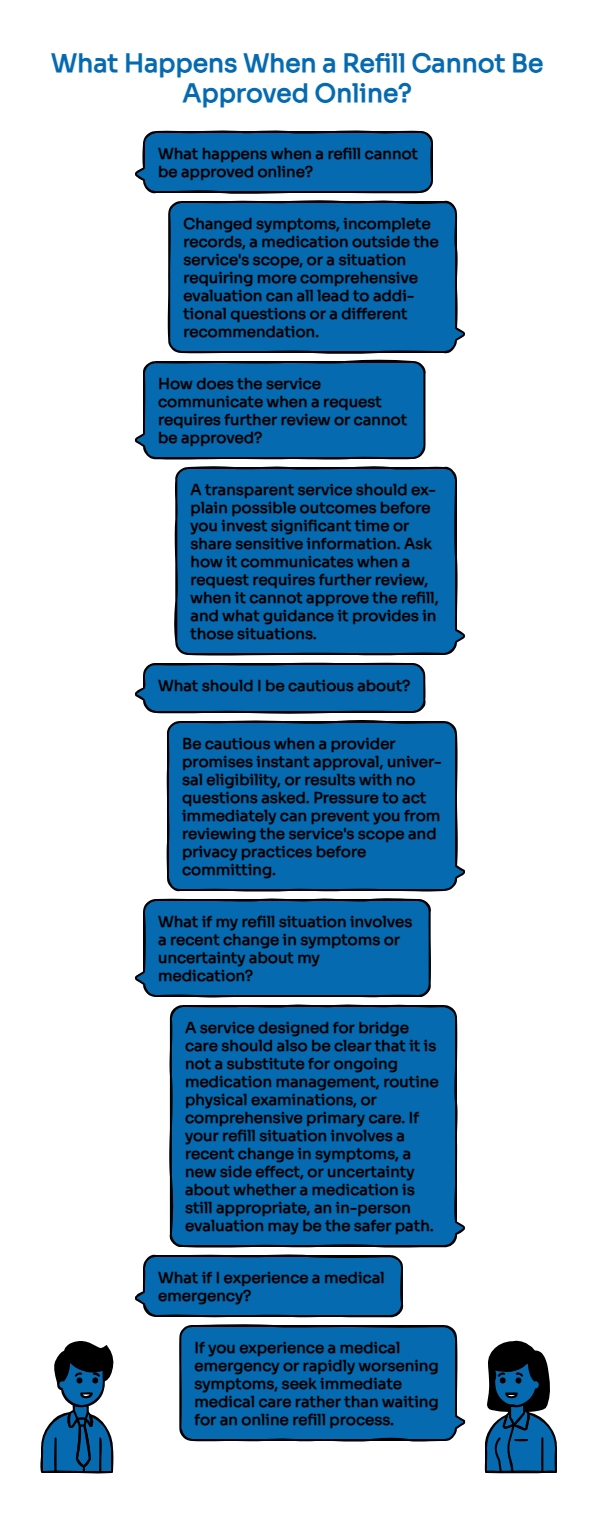
Not every refill request will result in a prescription being sent to your pharmacy. Changed symptoms, incomplete records, a medication outside the service’s scope, or a situation requiring more comprehensive evaluation can all lead to additional questions or a different recommendation.
A transparent service should explain possible outcomes before you invest significant time or share sensitive information. Ask how it communicates when a request requires further review, when it cannot approve the refill, and what guidance it provides in those situations. A clear process for handling non-routine requests, including referral to another care setting when appropriate, reflects responsible boundaries rather than poor service.
Be cautious when a provider promises instant approval, universal eligibility, or results with no questions asked. Pressure to act immediately can prevent you from reviewing the service’s scope and privacy practices before committing. A responsible provider should allow its published process and limitations to be examined without using urgency or certainty to force a decision.
A service designed for bridge care should also be clear that it is not a substitute for ongoing medication management, routine physical examinations, or comprehensive primary care. If your refill situation involves a recent change in symptoms, a new side effect, or uncertainty about whether a medication is still appropriate, an in-person evaluation may be the safer path. Repeated reliance on a temporary bridge service when your situation calls for continued monitoring or a medication change is not a substitute for reconnecting with a regular provider. You can explore how new symptoms or side effects may affect a refill review for additional context.
If you experience a medical emergency or rapidly worsening symptoms, seek immediate medical care rather than waiting for an online refill process.
Compare the Answers, Not Just the Promises
Once you have asked these questions, organize the answers side by side. The table below offers a quick way to sort transparent responses from language that warrants caution.
| Criterion | Clear answer looks like | Caution sign |
|---|---|---|
| Service fit | Published existing-prescription scope and stated limitations | Vague eligibility or claims of universal coverage |
| Clinical review | Named clinician role, described review process, and follow-up pathway | ”Instant approval” or “automatic” language |
| Information requirements | Specific intake categories explained | Little or no health information requested |
| Privacy | Accessible, detailed privacy explanation | ”Secure” without supporting detail |
| Unapproved requests | Defined next-step process when a request cannot proceed | No stated outcome for declined requests |
| Availability | Current state or jurisdiction verification | Assumed nationwide access |
Watch for language that sidesteps the questions entirely. Phrases such as “guaranteed approval,” “no questions asked,” “every medication qualifies,” or pressure to submit immediately can signal that the service has not explained its review process, eligibility boundaries, or fallback pathway.
Before you submit health information to any service, compare each provider’s answers in writing. A service that clearly explains its scope, clinician involvement, information requirements, privacy protections, and limitations gives you a stronger basis for confidence than one that emphasizes speed or simplicity without addressing those questions.
Frequently Asked Questions
Can an online refill service guarantee that my prescription will be approved?
No. A refill request should be evaluated through individual clinical review. The reviewing clinician considers your health information, medication details, and applicable eligibility requirements before deciding whether transmitting a prescription is appropriate. Additional information or a different care pathway may be recommended.
How can I verify who reviews an online prescription refill request?
Look for the clinician type, professional credentials, relevant licensing information, and the states the service currently covers. Common credentials to look for include MD (Medical Doctor), DO (Doctor of Osteopathic Medicine), NP (Nurse Practitioner), or PA (Physician Assistant). The service should also explain its review process, including how follow-up questions are handled. Confirm details that may change over time — such as state availability or specific clinician roles — through the service’s current published information rather than relying on older references.
What information should I gather before submitting a refill request?
Prepare your current prescription-label details (medication name, strength, and directions), prescriber contact information, pharmacy name and phone number, current allergies and other medications, and any relevant recent health changes. Requirements vary by service, so confirm what is needed before you begin.
Can I use an online refill service from any US state?
Availability can depend on the service and where its clinicians are authorized to practice. A nationally written website does not guarantee that the service operates in every state. Verify current availability directly with the service before submitting your request.
Does HIPAA automatically apply to every online refill or health service?
Not necessarily. Coverage can depend on the type of organization and how it handles health information. Rather than assuming protections apply, review the service’s current privacy notice and ask specific questions about data handling. Current federal guidance can help clarify what protections may apply.
Use Clarity as the Deciding Standard
The most useful online refill services make their process, boundaries, and limitations visible before you commit your time or information. Transparency about clinician review, eligibility, privacy, and what happens when a request needs more evaluation is a better measure of trust than a streamlined interface or a speed promise.
Use the nine-question checklist to compare services on the criteria that matter most. Once you have the answers, you can check whether your existing medication may be eligible for review — without assuming that eligibility, approval, timing, or pharmacy fulfillment is guaranteed.
Disclaimer: This article is for general educational purposes only and is not a substitute for medical advice, diagnosis, or treatment. Eligibility for an online prescription refill depends on individual clinical review and applicable requirements. If you have severe or rapidly worsening symptoms or believe you may have a medical emergency, seek immediate medical care.
Our Editorial Process:
Our content is developed to help readers understand common refill-gap situations, online refill boundaries, and temporary bridge-care options in plain language. We use Refill Genie source materials, service pages, FAQs, customer-feedback patterns, and relevant external authority sources to guide factual accuracy. Health-related content should be reviewed for clinical accuracy, eligibility language, safety limits, pricing, timing, and commercial terms before publication.
About the Refill Genie Insights Team
The Refill Genie Insights Team is our dedicated engine for synthesizing complex topics into clear, helpful guides. While our content is thoroughly reviewed for clarity and accuracy, it is for informational purposes and should not replace professional advice.