
August 14, 2026
What Health Information May Be Needed Before an Online Prescription Refill Is Reviewed
📌 Key Takeaways
Online refill reviews work best when patients share clear medication details, health changes, and safety concerns before clinician review.
-
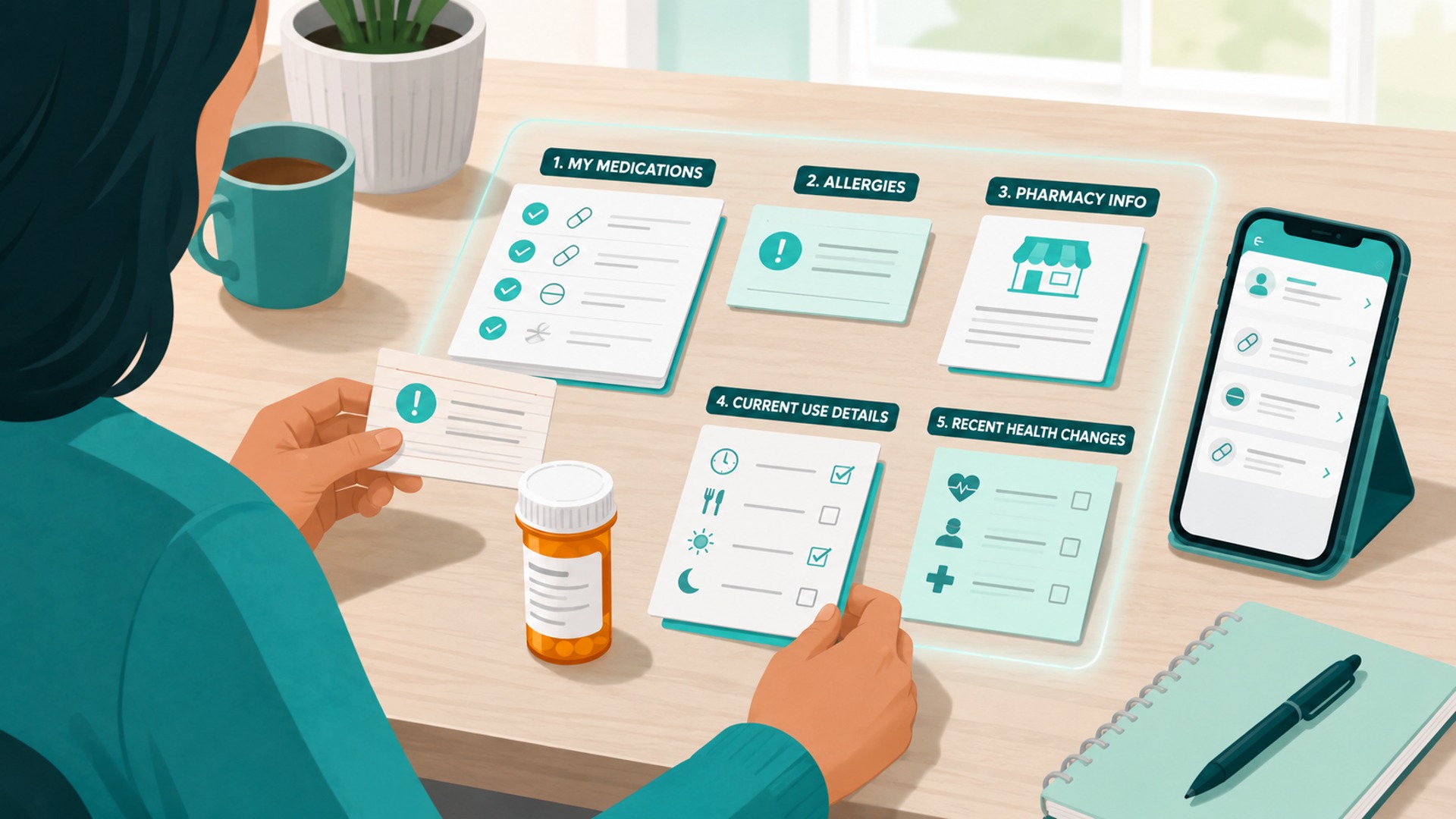
Prepare Key Details: The author recommends gathering the medicine name, strength, dose, pharmacy, prescriber, and current use before starting.
-
Share Health Changes: New symptoms, side effects, dose changes, or missed doses may change how a clinician reviews the request.
-
Use Current Records: A bottle, pharmacy app, patient portal, or recent record can help confirm details when memory is unclear.
-
Know Service Limits: RefillGenie reviews existing medication refills, but it does not diagnose acute conditions or start new medications.
-
Choose Care Wisely: Severe or life-threatening symptoms need urgent or emergency care, not a routine online refill request.
Clear details help clinicians review refills safely.
Patients seeking online refills will reduce confusion with these steps, preparing them for the refill review guidance below.
You may be running low on an existing prescription and trying to submit an online refill request before the day gets busy. Even when the medication is something you already take, a licensed clinician may still need enough health context to decide whether online review is appropriate.
In general, useful refill information may include the medication name, strength, dose schedule, current use, health history, symptoms, side effects, allergies, other medications, pharmacy details, and relevant records. Not every request needs the same details. The information needed can vary by medication, patient history, and clinician review.
The points below combine RefillGenie’s service details with general medication-safety preparation principles. If a detail depends on the medication or the clinician’s judgment, this guide notes the exception.
Why an Online Refill Review May Ask for Health Information
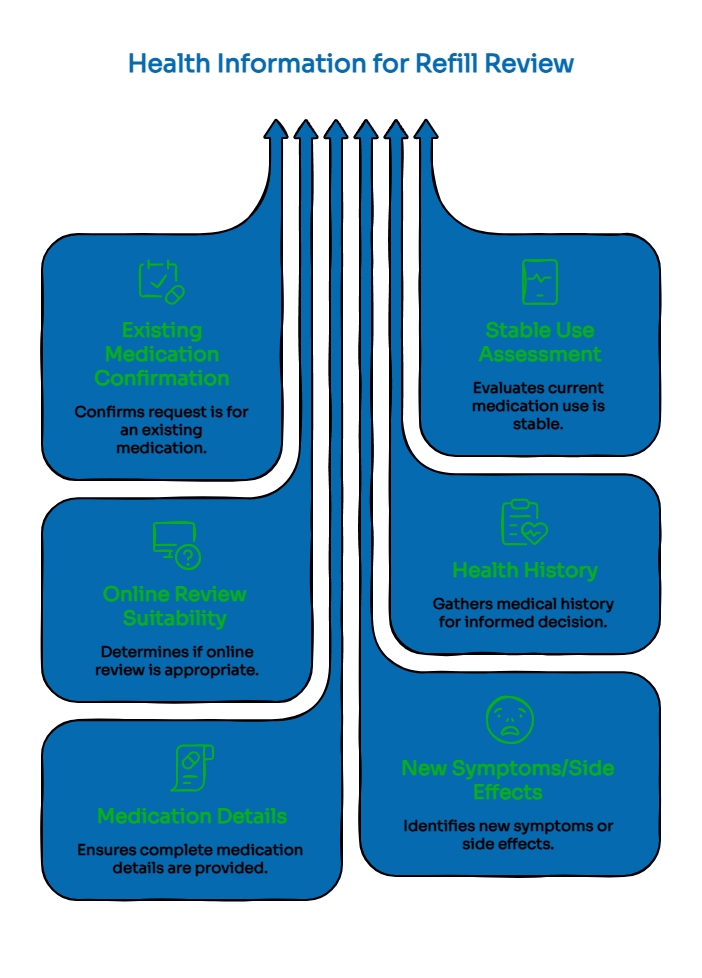
An online refill review is not just a convenience form. A clinician may need to confirm that the request involves an existing medication, that the current use appears stable, and that online review fits the situation.
RefillGenie asks users to answer medical-history questions before a doctor reviews the request. If appropriate, an e-prescription for a refill of an existing medicine may be sent electronically to a local pharmacy. This distinction matters because clinical review does not guarantee automatic approval.
Health details also help prevent confusion. A medication name without the strength, directions, pharmacy, prescriber, or recent-use details may leave important gaps. A request that includes new symptoms, side effects, recent dose changes, or monitoring concerns may need closer review.
RefillGenie is designed for clinician-reviewed refills of existing medications. It is not meant to diagnose acute conditions, treat severe symptoms, or start new medications. That boundary is important throughout the refill process.
Quick Checklist: Health Information to Gather Before You Start
Use this as a preparation checklist, not a universal eligibility rule. Some items may not apply, and some medications may require additional clinician review.
| Information | What to Prepare | Why It Helps |
|---|---|---|
| Medication details | Name, strength, dosage form, dose schedule, and how it is taken | Reduces confusion between similar medication names, strengths, or directions |
| Current use | How long the medication has been taken and whether it is still being used as prescribed | Helps show whether the request is for an existing medication |
| Refill timing | Last fill date, doses remaining, or estimated run-out date | Gives context for refill urgency |
| Prescriber details | Current or previous prescriber, if available | Helps clarify where the medication plan came from |
| Pharmacy details | Pharmacy name, location, and phone number | Helps route the prescription if the refill is appropriate |
| Health history | Relevant conditions, past diagnoses, or recent health changes | Gives the clinician broader context |
| Symptoms | New, worsening, or unusual symptoms | May affect whether routine online review is the right next step |
| Side effects | Any reaction, tolerability concern, or change in how the medication feels | Helps identify concerns that may need follow-up |
| Other medications | Prescriptions, over-the-counter medicines, supplements, and herbs | Helps keep the medication list current |
| Allergies or reactions | Medication allergies and prior side effects | Helps avoid missing important safety context |
| Records | Prescription bottle, pharmacy app, patient portal, or recent documentation | Helps confirm details when memory is incomplete |
| Monitoring history | Recent labs or monitoring information, if relevant | Some medications may need closer follow-up or bloodwork |
MedlinePlus advises patients to tell healthcare providers about allergies, past medicine side effects, and all medicines, supplements, and herbs they take. It also recommends bringing a medicine list or the medicines in their containers to appointments. That is a general medication-safety principle, not a guarantee that every online refill review will require the same items.
For a related preparation resource, RefillGenie also has a guide on records to gather before requesting an online refill.
Medication Details That Help a Clinician Understand the Request
Exact medication details matter because “I need my refill” may not identify the prescription clearly enough. The clinician may need the medication name, strength, dose, frequency, route, and dosage form.
A prescription bottle can help because it often shows the medication name, strength, directions, prescriber, pharmacy, and fill information in one place. If the bottle is old, damaged, or different from the latest instructions, check the pharmacy app or patient portal for a more current record. If you cannot find your pill bottle or do not have access to a patient portal, you can call your current pharmacy and ask them to read your latest prescription details to you over the phone
It also helps to say whether the request is for an existing medication. In this article, “existing medication” means a medication that has already been prescribed and is being taken as part of an established treatment plan.
The FDA notes that patients can use FDA-approved Medication Guides, Drugs@FDA, and DailyMed to find approved information about medicines. These resources can help when checking official medication information, but they should not be used to self-diagnose or decide whether a refill should be approved.
Health History, Symptoms, and Side Effects to Mention
Health history matters because the clinician needs to evaluate the whole patient, not just the prescription. Relevant conditions, past diagnoses, allergies, medication reactions, and current medicines can help the clinician review the request more clearly.
Mention symptoms when they are new, worsening, or different from the usual pattern. This does not mean every symptom makes online review inappropriate. It means symptoms can change the context. A clinician may need more information, recommend another type of care, or decide that the situation needs more than a routine refill review.
Side effects should also be shared. Some people worry that reporting side effects will slow things down, but leaving them out can make the review less complete. The FDA advises patients to work with a healthcare professional when side effects occur and provides resources for learning about drug side effects.
Use plain, specific wording. For example:
-
“The dose changed recently.”
-
“A new symptom started last week.”
-
“The pharmacy label says 10 mg, but my patient portal says 20 mg.”
-
“The bottle says once daily, but my prescriber told me to take it twice daily.”
-
“This medication has been causing a side effect that has not been reviewed yet.”
These details give the clinician useful context without turning the request into self-diagnosis.
Recent Changes That May Complicate a Refill Review
Recent changes may not prevent review, but they can make the request less straightforward. Be ready to explain what changed, when it changed, and who recommended it.
Examples of recent changes include:
-
A dose change since the last refill
-
A mismatch between the prescription bottle and the patient portal
-
A pharmacy label that shows old directions
-
A new medication added by another clinician
-
A stopped medication that still appears on the medication list
-
Missed doses or several days without medication
-
New side effects or tolerability concerns
-
A new diagnosis or recent urgent care visit
-
Abnormal lab results related to the medication
-
A change in prescriber or pharmacy
A dose mismatch is especially important to state clearly. For example, the bottle may say “take one tablet daily,” while the latest portal message says “take two tablets daily.” Or the pharmacy may have filled a 25 mg strength when the patient expected 50 mg. Do not guess whether the mismatch is medically significant. Just describe it accurately so the clinician can review it.
Some medications may require monitoring. RefillGenie states that certain medications requiring monitoring may not be refillable through its service and that bloodwork may be advised in some cases. Monitoring needs vary by medication and patient situation, so patients should consult their prescriber about recommended lab work or follow-up testing.
Missed doses or running out can also matter. State how many doses remain, when the last dose was taken, and whether any symptoms or concerns have appeared.
When Online Refill Review May Not Be the Right Next Step
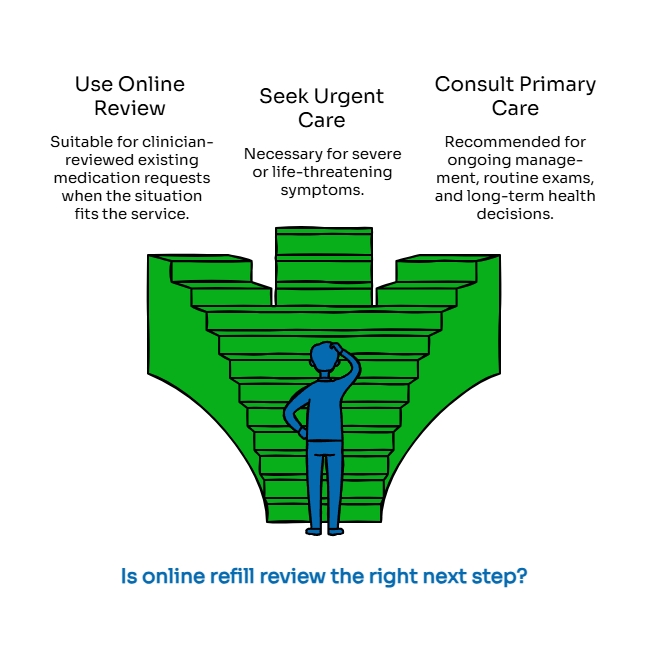
Online refill review may not fit every medication or situation. It is different from diagnosing a new condition, treating severe symptoms, replacing emergency care, or managing long-term primary care.
Beyond the existing-medication boundary, RefillGenie lists excluded categories such as controlled substances, sedatives, muscle relaxants, GLP-1 injections, erectile dysfunction medications, medications requiring monitoring, hormone replacement therapy, and other medications deemed unsafe to refill by the doctor. These are RefillGenie service boundaries, not universal rules for every online provider.
Online review may also be the wrong setting when symptoms are severe or life-threatening. MedlinePlus explains that people should go to the emergency room for emergency care and call 911 if they think the problem is life-threatening.
A simple boundary can help: use online refill review for a clinician-reviewed existing medication request when the situation fits the service. Seek urgent or emergency care for severe or life-threatening symptoms. Work with a primary care provider for ongoing management, routine exams, medication monitoring, and long-term health decisions.
For more context on fit, see RefillGenie’s article on online refill eligibility when your chronic condition is stable.
How to Keep the Review Process Smooth Without Hiding Important Details
The clearest request is usually the smoothest request. Gather the label, pharmacy details, prescriber information, recent changes, side effects, allergies, and other medications before starting. If a clinician may follow up by text, keep phone access available.
Be concise, but do not leave out important concerns. “No changes, no side effects, same dose, same pharmacy” is useful when accurate. “Same medication, but new side effects and a recent dose mismatch” is also useful because it tells the clinician the request may need more context.
This is especially helpful for busy professionals trying to handle a refill during the workday. Preparation can reduce back-and-forth, but it should never come at the cost of leaving out symptoms, side effects, or recent changes. RefillGenie’s related article on how to prepare for an online prescription refill during a workday may help readers organize the practical details.
FAQs About Health Information for Online Refill Review
Do prescription bottles help with an online refill review?
Yes. A prescription bottle may show the medication name, strength, directions, prescriber, and pharmacy. It is not safe to assume the bottle is always enough, especially if the label is outdated, damaged, or different from the latest instructions.
Why would a clinician ask about symptoms if this is only a refill?
Symptoms can help the clinician understand whether the medication situation appears stable or whether another type of care may be needed. New, worsening, or unusual symptoms should be disclosed.
Should side effects be mentioned before asking for a refill?
Yes. Side effects or concerns should be shared before review. General online information should not be used to stop, restart, or change a medication without guidance from a licensed healthcare professional.
What counts as a recent change?
Recent changes may include a new dose, a different strength, a pharmacy label that does not match current directions, a newly added medication, missed doses, new side effects, abnormal lab results, or a change in prescriber.
Can an online refill service start a new medication?
RefillGenie is designed for existing medication refills. Requests for a new medication or new treatment need may require a different type of clinical evaluation.
Are all medications eligible for online refills?
No. RefillGenie excludes certain medication categories and medications deemed unsafe by the doctor. Eligibility can depend on the medication, the health context, and clinician review.
What if symptoms feel severe?
For severe or life-threatening symptoms, seek urgent or emergency care rather than relying on a routine online refill request.
A Responsible Next Step
Before submitting an online refill request, organize your current prescription information and relevant health details. Clear information can help the clinician review the request with better context.
If you already take the medication and need a clinician-reviewed refill option, start with RefillGenie’s online prescription refill page. RefillGenie functions as temporary bridge support for existing medications, not a replacement for primary care.
Disclaimer: This article is for general informational purposes only and does not constitute medical advice, diagnosis, or treatment. Readers should consult a licensed healthcare professional for guidance specific to their health, symptoms, medications, or treatment options.
Our Editorial Process:
Our expert team uses AI tools to help organize and structure our initial drafts. Every piece is then extensively rewritten, fact-checked, and enriched with first-hand insights and experiences by expert humans on our Insights Team to ensure accuracy and clarity.
By: The Refill Genie Insights Team
The Refill Genie Insights Team is our dedicated engine for synthesizing complex topics into clear, helpful guides. While our content is thoroughly reviewed for clarity and accuracy, it is for informational purposes and should not replace professional advice.