
October 23, 2026
Prozac Refill Request Questions: Which Details Should You Have Ready?
📌 Key Takeaways
The author recommends preparing current prescription details and health information so a clinician can assess an established Prozac refill request.
-
Preparation Supports Review: The author recommends having your latest label, health history, remaining supply, and prescriber and pharmacy details ready.
-
Changes Need Attention: The author recommends reporting dose changes, new symptoms, side effects, and other medicines for the clinician to assess.
-
Approval Is Not Guaranteed: Clinicians make a fresh prescribing decision for each request and may need more information or further assessment.
-
Follow-Up Replies Matter: The author recommends staying available for clinician questions, since prompt replies can help the review move forward.
-
Pickup Is a Separate Step: An electronic prescription goes to your pharmacy after approval, but filling times vary and pickup may take longer.
Current information supports review; clinicians decide whether to prescribe.
Busy professionals with established Prozac prescriptions will find preparation questions and guidance on keeping refills within ongoing care below.
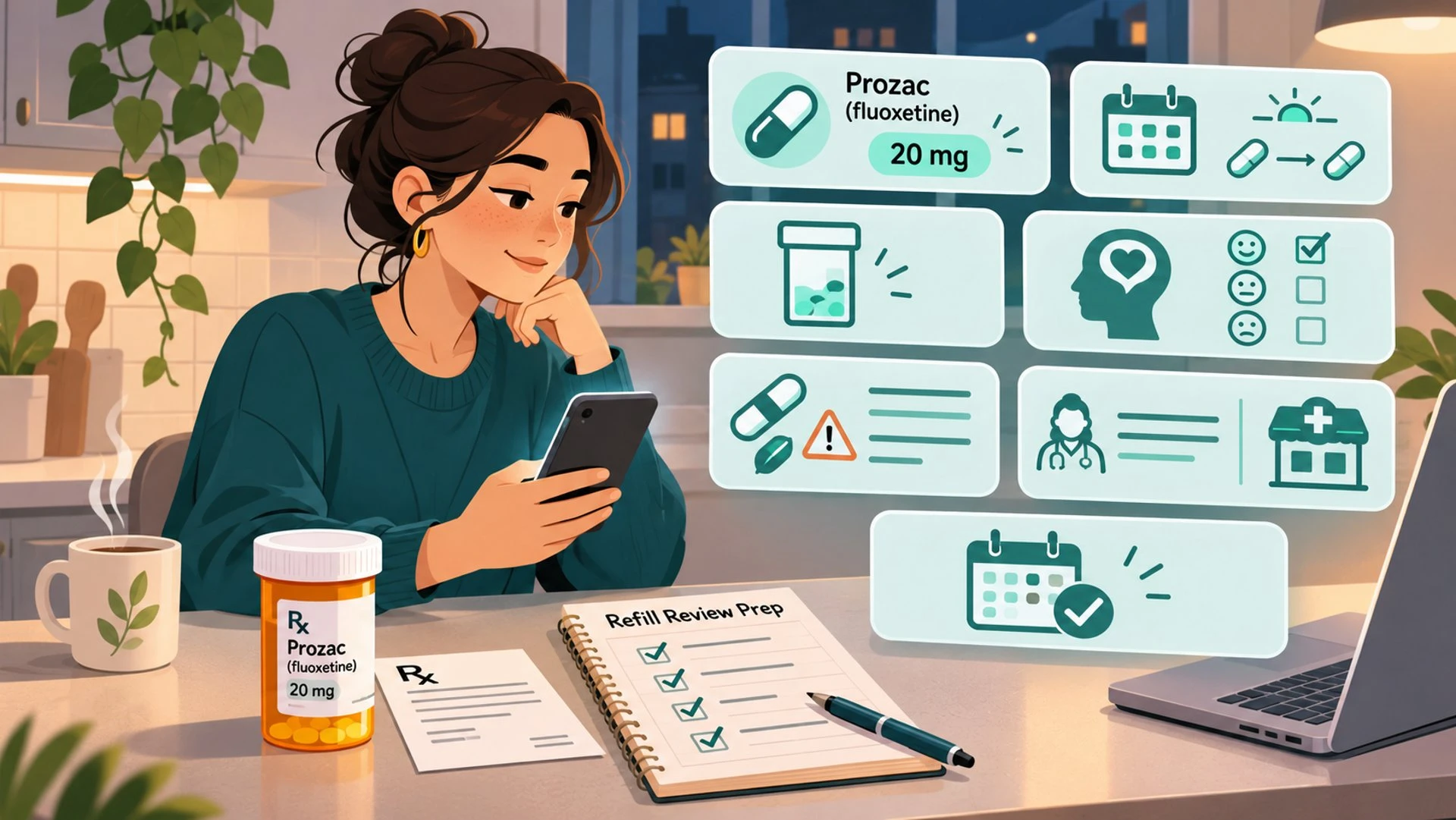
Your Prozac bottle feels lighter tonight.
At 6:20 p.m., the faint rattle of the last few tablets prompts a quick count at the kitchen counter. The prescription label sits beside a phone already lit with tomorrow’s 8:05 a.m. meeting alert. There’s no open slot on this week’s calendar.
You already take Prozac, so the routine is familiar. The harder part is knowing what a clinician will need from you before reviewing a refill request. The direct answer is to have these ready: your current label details, accurate health-history information, any recent changes, your prescriber and pharmacy details, and time to answer follow-up questions. Preparing these supports a review. It does not mean a refill will be approved.
This guide covers that preparation for people with an established Prozac prescription whose usual prescriber is unavailable. In that situation, an online refill can work as a temporary bridge in established care. The reviewing clinician keeps full prescribing discretion.
Quick Answer: What Details Should You Have Ready for a Prozac Refill Request?
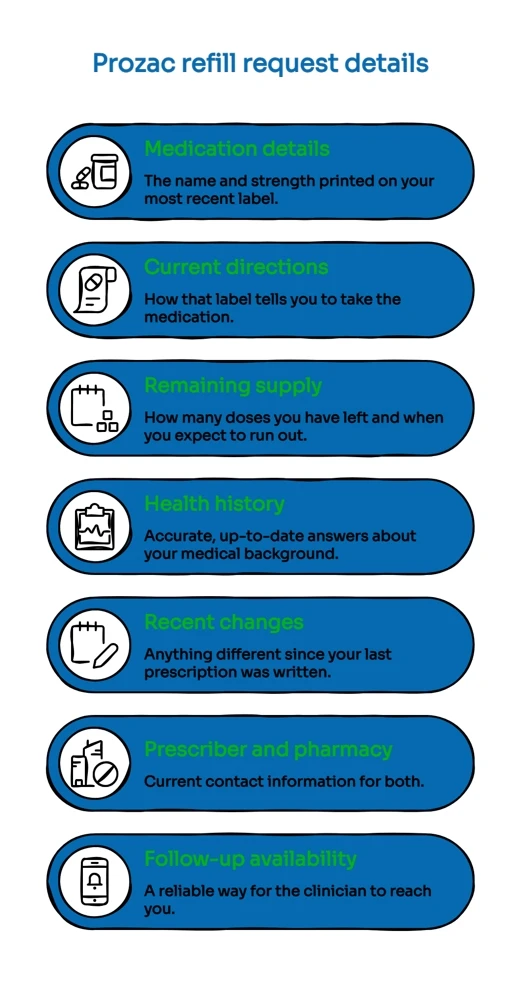
For an established Prozac (fluoxetine) prescription, seven categories of information help a reviewing clinician understand your request. These are preparation categories, not an eligibility test. The exact details a clinician asks for can vary with your circumstances and the service involved.
-
Medication details: the name and strength printed on your most recent label.
-
Current directions: how that label tells you to take the medication.
-
Remaining supply: how many doses you have left and when you expect to run out.
-
Health history: accurate, up-to-date answers about your medical background.
-
Recent changes: anything different since your last prescription was written.
-
Prescriber and pharmacy details: current contact information for both.
-
Follow-up availability: a reliable way for the clinician to reach you.
Why Current Information Matters Even When You Already Take Prozac
An established prescription shows that Prozac was considered appropriate for you at some point. It doesn’t settle whether another prescription is appropriate today.
That gap is easy to overlook. The useful question isn’t simply whether you have taken Prozac before. It’s whether the clinician reviewing your request has accurate, current information to assess it now.
Refill Genie’s Prozac refill service information describes a process in which patients answer health-history questions before a clinician makes any decision. The same documentation positions the service as support for existing prescriptions, not a way to start new treatment.
As a general principle of prescribing, a renewal is a fresh clinical decision rather than a copy of the last one. Online access changes how you communicate with a clinician. It doesn’t remove the need for an assessment.
For independent background on the medication itself, MedlinePlus offers patient-facing fluoxetine drug information from the U.S. National Library of Medicine.
A Question-Led Prozac Refill Preparation Checklist
Each question below helps you organize information. None of them determines whether a refill is appropriate. That decision stays with the clinician.
What Does Your Current Prescription Label Say?
Work from the physical label on your most recent bottle, not from memory. Note the medication name, strength and directions exactly as printed. If your directions changed recently, confirm that the label in your hand reflects the change. If it doesn’t match your prescriber’s latest instructions, point out the difference when you submit your request.
For example, someone submits a request between meetings the day before a flight and copies the strength from an older bottle in a desk drawer. The clinician spots the mismatch and texts a question that goes unanswered until evening. One outdated label costs most of a day.
If you have questions about taking your medication while you wait, raise them with a clinician rather than adjusting anything yourself. If you have completely run out of your medication and risk missing a dose before a clinician can review your request, contact your local pharmacy. Pharmacists can sometimes provide a short emergency supply (often 3 to 5 days) of non-controlled medications like Prozac to prevent withdrawal symptoms while you await a new prescription.
Is Your Health Information Current?
A reviewing clinician may not have access to your complete medical history, which is why the health questions matter. Refill Genie’s documentation describes a medical-history review as part of its process.
Accuracy matters more than volume here. If you’re unsure about a detail, say so instead of guessing. If a question itself is unclear, ask the clinician to clarify it through the service’s secure channels. How much you share is your decision, although incomplete answers may limit what a clinician can assess.
Has Anything Relevant Changed?
Write down each change since your last prescription, with an approximate date. A dated note takes two minutes and can spare you a round of follow-up messages.
Do You Have the Right Prescriber and Pharmacy Information?
Confirm your regular prescriber’s name and contact details. Also confirm the pharmacy where you would want a prescription sent if one is issued. These details are simple, yet they go stale quickly when a prescriber changes practices or your routine has shifted since your last prescription renewal.
Can You Respond to Follow-Up Questions?
Refill Genie describes text-based contact with the reviewing clinician. On a day packed with meetings, submit when you can realistically check your phone. Prompt replies keep a review moving. They don’t change the clinical outcome.
Changes Worth Flagging for the Reviewing Clinician
Should You Mention a Dose or Health Change Before a Refill?
Yes. Changes a reviewing clinician may need to assess include:
-
a dose that differs from what was previously prescribed;
-
new symptoms or side effects;
-
other medications you have started or stopped;
-
health history that is incomplete or out of date.
Any of these can make a request less routine. That doesn’t automatically rule out a refill. It may simply mean the clinician needs more information first. Refill Genie’s service documentation notes that further assessment or bloodwork may be requested in some circumstances. Whether that applies to a particular Prozac request is a clinical judgment.
Your role is accurate reporting, not interpretation. As general practice, mention supplements and over-the-counter products as well, since some can interact with antidepressants. The FDA’s consumer guide to depression medicines is a helpful reference for questions to raise with a healthcare professional about other products you take. For guidance on what a specific change means for your treatment, speak with a qualified clinician.
Severe symptoms are a different matter. If you develop them, seek urgent medical attention rather than relying on a routine refill request.
A Prepared Request Is Still a Clinician-Reviewed Request
You control the preparation. The clinician controls the prescribing decision. That decision can include further questions, a recommendation for additional assessment, or a conclusion that renewal isn’t appropriate through the service.
Sometimes the problem isn’t how quickly you submit. It’s the assumption that a fast request means an approved refill that is ready to collect.
What Happens After a Prozac Refill Request Is Submitted?
Refill Genie describes its online prescription refill service in distinct stages:
-
You answer health-history questions.
-
Your information is verified.
-
A clinician contacts you by text.
-
The clinician makes a prescribing decision.
-
When clinically appropriate, an electronic prescription is sent to your pharmacy.
Filling that prescription is a separate step. A transmitted prescription doesn’t mean the medication is ready for pickup at that moment, and timing at each stage can vary.
For common process questions, the Refill Genie frequently asked questions page is the clearest place to look. Independent customer impressions appear on Refill Genie’s Trustpilot profile. Treat those as individual experiences, not predictions for your own request.
Keep a Refill Request in the Context of Ongoing Care
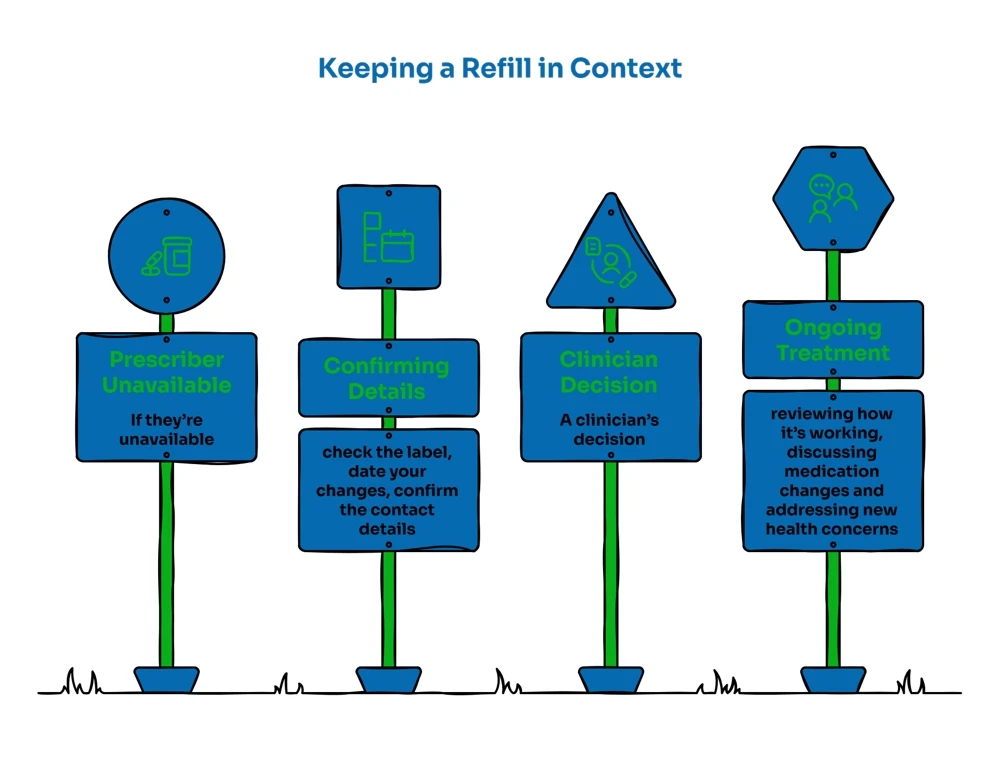
Back at the kitchen counter, the bottle is still light. What has changed is the plan. Contact your regular prescriber first. If they’re unavailable, check the label, date your changes, confirm the contact details and keep your phone within reach.
That is the practical core of Prozac refill readiness for busy professionals. When a clinician approves it, a refill works as a continuity bridge between appointments, covering gaps created by work commitments, travel or a lack of available appointments. It is not the road itself. Your regular prescriber remains the person who manages your treatment over time: reviewing how it’s working, discussing medication changes and addressing new health concerns.
Current details. Honest answers. A clinician’s decision.
If practical refill-planning guidance is useful to you, subscribe to the Refill Genie newsletter for future educational updates.
Disclaimer: This article provides general information about preparing for an established Prozac refill request for educational purposes. Individual circumstances vary significantly based on factors such as your current prescription information, health history, recent treatment or symptom changes, and the clinician’s assessment. For personalized guidance about your medication and refill needs, consult a qualified healthcare professional.
Our Editorial Process
Our team uses AI tools to help organize and structure initial drafts. Content is intended to undergo human editorial review and appropriate medical fact-checking before publication.
By: The Refill Genie Insights Team
The Refill Genie Insights Team is our dedicated engine for synthesizing complex topics into clear, helpful guides. While our content is thoroughly reviewed for clarity and accuracy, it is for informational purposes and should not replace professional advice.