
November 6, 2026
Prozac Refill Planning for Busy Professionals: Why Waiting Until the Last Dose Can Backfire

📌 Key Takeaways
Planning an established Prozac refill early can help busy professionals leave time for clinical review and pharmacy processing.
-
Timing Depends on Access: The author recommends comparing remaining doses with work commitments and prescriber availability before the bottle runs low.
-
Accurate Details Support Review: Current prescription details and complete health information can reduce follow-up questions, though they cannot guarantee refill approval.
-
Requests Still Need Approval: A clinician decides whether a refill is appropriate, even when the prescription already forms part of ongoing treatment.
-
Pharmacy Timing Is Separate: A clinician’s response does not mean medication is ready; pharmacy processing adds a separate step with variable timing.
-
Changes Need Clinical Guidance: The author recommends clinician guidance for missed doses, new symptoms, or treatment changes instead of relying on routine renewal.
Early planning leaves time for review and pharmacy processing.
Busy professionals taking established Prozac prescriptions will find help organizing refill details through the planning checkpoint and worksheet below.
The bottle sounds lighter than expected.
It’s 6:20 p.m. The kitchen counter still holds a laptop bag and a stack of unopened mail. A quick shake of the Prozac bottle produces a faint, thin rattle, prompting you to pour the tablets into your palm and count them. Then the phone calendar opens: back-to-back meetings starting Monday, a flight on Wednesday, and no obvious gap for a call with the regular prescriber. Many working adults will recognize this familiar scenario.
When did this get so low?
Prozac refill readiness for busy professionals means checking your remaining supply, your current directions, your upcoming schedule and your access to the usual prescriber before the bottle runs low. It is a way to prepare for continuity of an established prescription. It does not substitute for clinician review, and it does not guarantee that a refill will be approved or available.
If you take an established Prozac prescription, you already know the routine. The timing is the hard part. Your remaining supply, your workweek and your prescriber’s availability each run on their own schedule, and nothing makes them line up. Waiting until the last few doses rarely creates the problem by itself. It simply removes the buffer you need to solve the problem calmly.
Once you can see those pieces side by side, your next move becomes obvious. You might request a review early, call your usual prescriber this week, or raise a change that deserves a real conversation.
Why the Last Dose Is a Poor Prozac Refill Planning Trigger
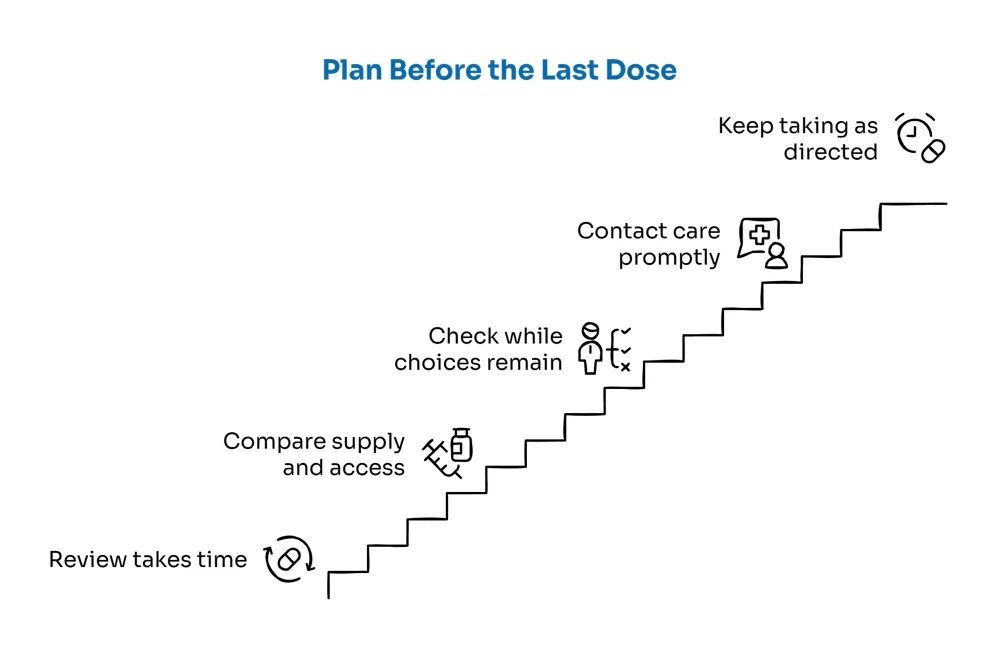
The last dose leaves almost no time for everything that has to happen after a refill request.
Refilling an established prescription takes several steps. A clinician reviews your request and decides whether a refill is appropriate. If it is, a prescription is sent, and then it has to be filled. Each step takes time, and that time comes out of the supply you have left. Smooth renewals in the past don’t change this, because each request still goes through the same steps.
The bottle can mislead you. Picture two working adults who each have nine doses left. One can reach a regular prescriber tomorrow and has nothing unusual on the calendar. The other faces several days of meetings, then a business trip, with little chance to contact the usual prescriber. The count is identical, but the time available to arrange a review is not. Your remaining supply only means something when you compare it with realistic access to clinical review.
You won’t find a universal “start your refill X days early” rule here. No clinician-validated number fits every prescription, dosing schedule and calendar. The general principle is simpler. Check your supply against your calendar while you still have choices, and treat the overlap between the two as your real planning window.
There’s a clinical reason this matters too. MedlinePlus advises taking fluoxetine exactly as directed and not stopping it without talking to your doctor. It also points patients to their pharmacist with refill questions. If your supply might run out before a review can happen, contact your prescriber or pharmacist promptly, and don’t change your dose or schedule to stretch what’s left. A Prozac refill is part of ongoing care, not just an errand to squeeze in between meetings. Fluoxetine stays in your system longer than many other antidepressants, but abruptly missing doses can still trigger discontinuation symptoms like irritability, brain zaps, or fatigue.
How a Packed Work Calendar Can Turn a Routine Refill Into a Timing Problem
A busy schedule doesn’t change what a refill requires. It changes how easily you can get the steps done. At 8:05 a.m., a reminder to call the prescriber’s office pops up at the same time as three meeting alerts. The reminder gets snoozed. By lunch it has been snoozed twice more, and by Friday the office is closed for the weekend.
Nothing in that sequence is careless. It’s what an ordinary busy week looks like. The friction tends to come from a handful of familiar sources:
-
Meetings that fill the business hours when prescriber offices are easiest to reach
-
Work travel or sudden schedule changes that shrink the days you have to follow up
-
A routine appointment that gets delayed or rescheduled
-
Forgetting to count remaining doses until the bottle is nearly empty
-
Working from an outdated prescription label whose details no longer match your current directions
The first item hides a subtle trap. A calendar can show several open evenings before your supply runs low and still offer almost no usable time, because those openings fall outside the hours when your prescriber’s office answers. Usable time is what counts.
Sometimes the obstacle isn’t the refill process at all. It’s the week wrapped around it. That’s why the usual instinct, submitting a request as fast as possible and assuming it will sort itself out, can backfire. A faster request doesn’t make approval certain, and it doesn’t make medication instantly available. It only moves the starting line.
Customer reviews on Refill Genie’s public profile reflect this kind of friction. Mary C. described traveling frequently for work and using the service to bridge the gap until her next in-person appointment. Another reviewer mentioned an appointment delay during a change of provider. These are individual experiences, not typical results. If a delayed appointment now falls beyond what your supply covers, tell your care team early.
Travel adds one more detail worth settling in advance: which local pharmacy should receive your prescription while you’re away. The guide to refill planning before travel or schedule changes covers that situation in more detail.
The fix isn’t more urgency. It’s an earlier, calmer check.
The Refill Readiness Checkpoint: Supply, Schedule and Current Prescription Details
A refill readiness checkpoint is a short review you do before requesting a Prozac refill. It covers five things: how many doses remain, what your current label says, what your calendar holds over the coming days, how reachable your usual prescriber is, and whether your medication and health information is accurate. Done early, it lowers the risk of an unplanned gap in your medication.
Remaining doses. Count them when you have a few focused minutes, not while you’re rushing out the door, and note the date you counted. An exact number is more useful than a guess like “about a week.” Keep in mind that the number of tablets doesn’t always equal the number of days left, since that depends on your directions.
The current label and directions. Your most recent label lists the medication name, strength and directions as they stand today. If you’ve been using an older bottle, use the newest label you have. If the label doesn’t match what your clinician last told you, ask the clinician to confirm your current directions rather than picking one yourself.
Your calendar. Look ahead across the days your supply covers. Mark the travel days, the all-day sessions and the stretches when you won’t be free during business hours. These are the moments when a follow-up question from a reviewer might go unanswered.
Prescriber access. Ask yourself honestly whether your regular prescriber can be reached within that window. If the answer is “probably not,” it’s far better to know now, while you still have options, than on the day the bottle runs dry.
Your information. A clinician reviews what you submit. Accurate, complete details make back-and-forth questions less likely, although they can’t guarantee approval.
This checkpoint doesn’t decide whether a refill is appropriate. A reviewing clinician makes that call. The checkpoint’s job is narrower: it puts you in a position to make a timely, well-prepared request. For general tips on fitting refill tasks into a working day, see how busy professionals can prepare for an online prescription refill during a workday.
What to Have Ready Before a Prozac Refill Review
The exact information a reviewer asks for can differ from one situation to the next. Commonly requested details include:
-
Medication name and strength as shown on your current label
-
Your dose schedule as directed
-
Your remaining supply and the date you counted it
-
Allergies, side effects and other medications you take
-
Your regular prescriber’s contact information
-
Accurate contact details, plus where your prescription should be sent
-
Any change since your last prescription, in your health, your dose or your other medications
That last item deserves extra attention. Mention any change up front instead of leaving it out. A change disclosed at the start can be weighed properly. One that surfaces halfway through can stall the review. MedlinePlus also recommends keeping a written list of every medicine and supplement you take, which makes this step much faster. For a closer look, read what health information may be needed before an online prescription refill is reviewed.
Why a Submitted Refill Request Still Needs Clinician Review
Submitting a refill request starts the process. It doesn’t finish it.
Refill Genie describes its Prozac Prescription Refill Online service as support for established prescriptions, not a way to begin new treatment. In the process it documents, a clinician reviews the medical-history information you submit and may text you to clarify details. When the clinician decides it’s appropriate, an electronic prescription can be sent to your local pharmacy. Sending that prescription is a clinical decision. It isn’t the automatic result of filling out a form.
Three points follow from this:
-
A request is not an approval. There’s a review step between the two.
-
An established prescription doesn’t remove clinical judgment. A reviewer may ask follow-up questions, request further evaluation, or decide that a standard renewal isn’t the right path.
-
A sent prescription doesn’t mean your medication is ready. Filling it is a separate step.
None of this is unusual. Refills of established Prozac prescriptions are a form of clinician-reviewed prescription renewal, and that review step is a safeguard rather than an obstacle. The FDA makes a related point in its consumer guidance on buying medicines safely online: it warns against online pharmacies that don’t require a doctor’s prescription. That guidance covers online medicine buying in general and doesn’t evaluate or endorse Refill Genie. Refill Genie is not a pharmacy. It’s a clinician-reviewed refill service. The principle still holds, though: a legitimate path to prescription medicine includes a qualified person checking that it’s appropriate.
To see how this works for refills in general, the online prescription refill page explains the overall process.
Clinician Response Time and Pharmacy Readiness Are Different Clocks
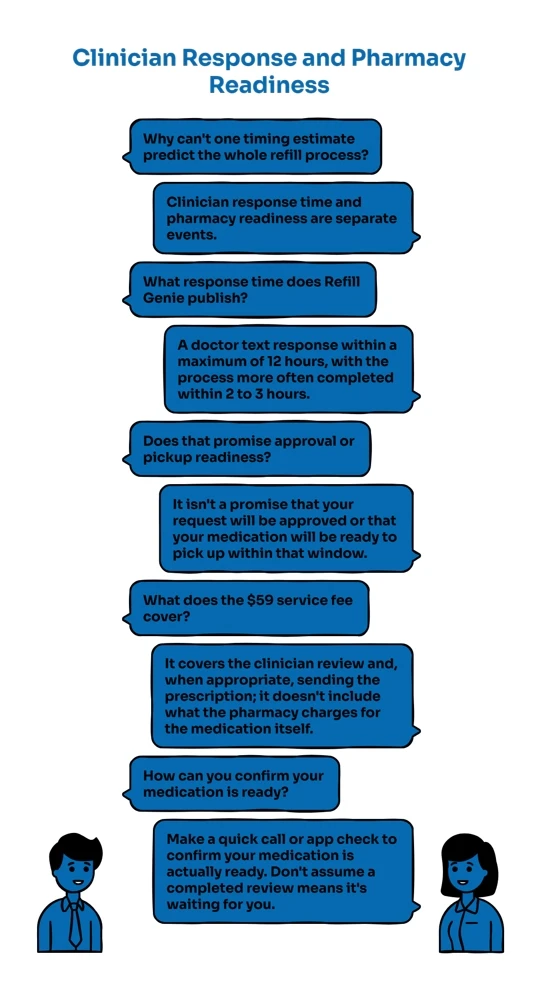
Clinician response time and pharmacy readiness are separate events, so one timing estimate can’t predict the other. This distinction matters most when you’re counting backward from your last dose.
Refill Genie publishes a timing claim for its service: a doctor text response within a maximum of 12 hours, with the process more often completed within 2 to 3 hours. That’s the service’s own description of how quickly a clinician responds. It isn’t a promise that your request will be approved, and it isn’t a promise that your medication will be ready to pick up within that window.
The same applies to cost. Refill Genie lists a $59 service fee for its 90-day refill, which covers the clinician review and, when appropriate, sending the prescription. It doesn’t include what the pharmacy charges for the medication itself, so confirm current terms with the provider before you submit.
The full journey has distinct stages:
-
You submit your request.
-
A clinician reviews your information.
-
If appropriate, an electronic prescription is sent to your local pharmacy.
-
The pharmacy processes the prescription.
-
Your medication becomes available for pickup.
The published response window describes the early part of that sequence. What happens at the pharmacy runs on the pharmacy’s own clock, including its hours, and that clock varies by location and circumstance. The sensible final step is a quick call or app check to confirm your medication is actually ready. Don’t assume that a completed review means it’s waiting for you.
Two separate clocks. Two separate confirmations.
For more on reading refill timing claims realistically, see what turnaround times really mean when planning an online medication refill.
When Routine Prozac Refill Planning Is No Longer Enough
The checkpoint is built for routine situations: the same medication, the same directions, no meaningful changes in your health, and current information ready to share. When any of those conditions shift, a checklist stops being the right tool.
A new symptom, or a change in how the medication seems to affect you, is a reason to talk with a clinician instead of simply renewing. So is a recent change to your dose or directions, a newly diagnosed condition, a new medication or allergy, or a side effect you haven’t discussed with your prescriber. Missing pieces of your prescription history belong in the same category. If you’ve already missed doses or are having concerning symptoms, seek guidance specific to your situation rather than waiting on a routine refill.
None of these is a precise clinical threshold, and no checklist can tell you exactly where routine ends. If you can’t tell whether your situation is still routine, that uncertainty is useful information in itself. Contact your usual prescriber or the reviewing clinician rather than working it out alone. For individualized medical guidance about your prescription, consult a qualified healthcare professional.
Use the Prozac Refill-Readiness Worksheet Before the Calendar Gets Tight
The worksheet below gathers the checkpoint into one place so you can see your supply, your schedule and your open questions together. It’s a proposed educational tool, not a downloadable resource or a clinical screening test. You might work through it on a quiet Sunday evening before a demanding week. It takes about ten minutes.
| Refill-readiness question | Reader entry |
|---|---|
| How many doses remain, and on what date did you count? | ___ |
| What does the current prescription label say? | ___ |
| Are there work, travel or schedule conflicts coming up? | ___ |
| When can the usual prescriber realistically be contacted? | ___ |
| Which pharmacy should receive the prescription? | ___ |
| Is the medication information current? | Yes / Needs checking |
| Are there health or medication changes that should be disclosed? | Yes / No / Unsure |
| What question needs to be answered before requesting review? | ___ |
This worksheet helps organize information. It does not determine whether a refill is clinically appropriate and does not replace clinician judgment.
The last two rows tend to be the most revealing. An “Unsure” in the changes row, or a blank in the final row, tells you a conversation should come before any request. A clean sheet tells you you’re ready to move ahead with confidence.
If the sheet shows a timing conflict, a short message to your prescriber’s office is usually the easiest next step:
“My established Prozac prescription may run low before my next appointment. I have my current medication details and remaining supply count ready. Could you advise on the right way to review my refill?”
A Better Goal Than Speed: Continuity With Realistic Clinical Boundaries
Go back to that kitchen counter at 6:20 p.m.
The faint rattle in the bottle was never the real problem. It was a signal to check whether supply, schedule, prescriber access and accurate information actually fit together. Seen that way, Prozac refill readiness for busy professionals is a process for continuity planning in established Prozac care, not a race to submit a form. It gives you confidence in making a timely, informed request because it respects every step that comes after the request.
That respect applies to the service side too. Refill Genie describes its refill service as a temporary bridge for established prescriptions during gaps in access. It isn’t a replacement for an ongoing relationship with a clinician who knows your history and can monitor your treatment over time. Keeping that relationship active is part of good planning. The article on the refill gap trap explores why that matters.
The goal was never the fastest possible refill. The goal is to be prepared early enough that the process can run on accurate information, within the time you actually have.
Count early. Check honestly. Ask before the week fills up.
If your checklist shows you are ready, you can start your Refill Genie review request here.
If you’re reviewing an established Prozac prescription and want to understand the available refill process, explore Refill Genie’s Prozac refill information and FAQs.
Disclaimer: This article provides general information about Prozac refill planning for busy professionals for educational purposes. Individual circumstances vary significantly based on factors like remaining medication supply, current prescription information, changes in health or treatment, and access to an appropriate clinician. For personalized guidance tailored to continuity of an established Prozac prescription, it is recommended to consult with a qualified healthcare professional.
Our Editorial Process
Our expert team uses AI tools to help organize and structure our initial drafts. Every piece is then extensively rewritten, fact-checked, and enriched with first-hand insights and experiences by expert humans on our Insights Team to ensure accuracy and clarity.
About the Refill Genie Insights Team
The Refill Genie Insights Team is our dedicated engine for synthesizing complex topics into clear, helpful guides. While our content is thoroughly reviewed for clarity and accuracy, it is for informational purposes and should not replace professional advice.