
September 11, 2026
Privacy and Record-Sharing Questions to Ask Before an Online Prescription Refill

📌 Key Takeaways
The author recommends clarifying how an online refill service uses and shares your information before submitting sensitive details.
-
Collection Needs Clear Reasons: A required field without an explanation raises questions about its purpose, but does not prove it is unnecessary.
-
Access May Extend Beyond Clinicians: Depending on the service, pharmacies and outside providers may also receive information for specific purposes.
-
Privacy Documents Serve Different Purposes: Privacy notices explain information practices, while consent and authorization language describe agreements or permissions that may differ.
-
Information Controls Can Vary: Options for correcting or deleting information may depend on the service, information type, and applicable law.
-
Security Claims Leave Questions: General security promises do not explain who can read messages, where copies remain, or how long services keep them.
Clear privacy answers support a more informed choice.
People considering online prescription refills will find questions for assessing information use and sharing in the checklist below.
You reach the refill form, and the process looks straightforward: name, date of birth, medical history, current medications, pharmacy preference. Then you pause. Where does this information go once you hit submit? Who reviews it, who stores it, and what happens to it after the prescription reaches your pharmacy?
That pause is worth acting on. A few targeted questions, asked before you share sensitive details, can help you evaluate whether a service explains its information-handling practices clearly enough for you to feel comfortable proceeding. What follows is a practical framework and a reusable checklist you can apply to any online refill service; it is not legal or medical advice.
Start With a Quick Privacy Fit Check
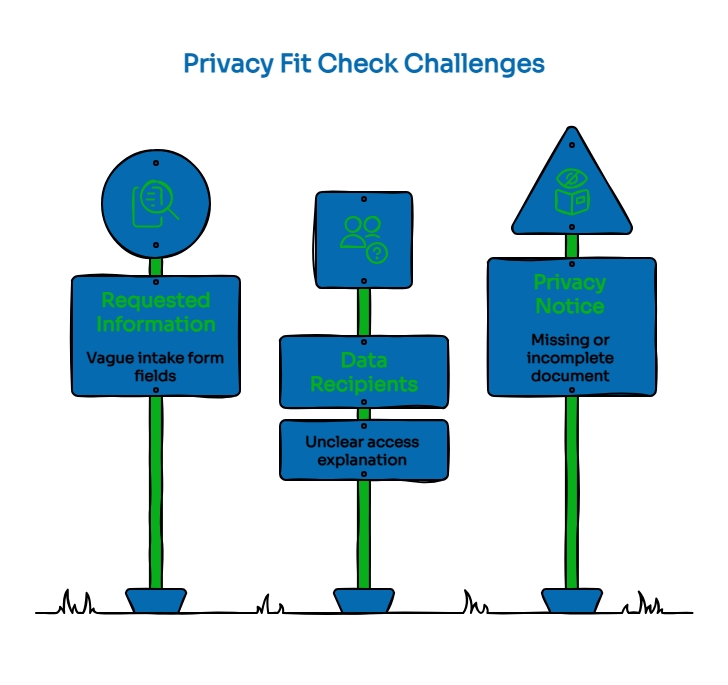
Before reading any detailed policy, run three immediate checks:
1. What is being requested? Scan the intake form for every required field.
2. Who may receive it? Look for a short explanation of which parties can access what you submit.
3. Where is the explanation? Confirm that a privacy notice or similar document is available before you complete the form.
A general reassurance statement, such as a compliance badge or a single sentence about security, is not the same as a complete explanation of how your health information is collected, used, accessed, and shared. If any of these three checks returns a vague answer or no answer at all, that is a reason to slow down and investigate further.
Identify Exactly What Information the Service Requests
Online refill services generally ask for several categories of information. Knowing what to expect makes it easier to spot requests that lack a clear purpose.
Common categories may include identity and contact details (name, date of birth, phone number, email, address), medical history and current health conditions, the name, strength, and dosage schedule of the medication you need refilled, your preferred pharmacy, and, when applicable, payment details. A note on terminology: “health information” refers broadly to the details you share during intake, while “medical record” typically refers to an official clinical document. Not every form response creates a medical record, so the distinction matters when you review a privacy notice.
The following table groups typical intake categories alongside the questions each one raises. Use it as a quick reference while reviewing a form:
| Information category | Purpose to ask about | Potential recipient to confirm | Where to look for an explanation |
|---|---|---|---|
| Identity and contact details | Verification and communication | Staff or disclosed supporting providers | Intake explanation and privacy notice |
| Medical history | Relevance to the clinical review | Reviewing healthcare professional | Form prompt and privacy notice |
| Current prescription details | Confirmation of the medication and directions | Reviewing clinician and pharmacy, when applicable | Intake and process explanation |
| Pharmacy information | Routing a prescription when appropriate | Selected pharmacy | Process page and privacy notice |
| Payment information, if applicable | Payment processing | Disclosed payment provider | Checkout notice and privacy notice |
Imagine a busy professional pausing at a required field labeled “additional medical history” that accepts open-ended text. The field offers no explanation of why this information is needed or how broadly it will be used. An unexplained field does not prove it is unnecessary, but it does justify asking what role the information plays in the review before completing it.
Ask Who Can Access or Receive the Information
Access and sharing are related but not identical. Access concerns who can view or use information within the service. Sharing concerns when information may be sent or made available to another person or organization outside it. Submitting information to a refill service does not mean only one person sees it, and several parties may be involved in a typical online refill workflow. Each one represents a separate question.
Internal reviewers. A clinician or medical team member typically reviews the health information you provide. Ask whether the service specifies who within the organization can view your submission and for what purpose.
Pharmacy. When appropriate, an electronic prescription for an existing medication may be sent to the user’s pharmacy. Pharmacy transmission is an expected part of a refill workflow, not a privacy failure. The question to ask is what information accompanies the prescription and whether the scope of that transmission is described.
Supporting service providers. Many online services use third-party technology for hosting, communication, payment processing, or other operational functions. If a privacy notice mentions “service providers,” “business associates,” or “trusted partners,” ask whether the notice explains who those parties are, what information they can access, what functions they perform, and what limits apply. A broad phrase without further detail is worth a follow-up question.
Other disclosures. A disclosure is any instance in which information is released to a party outside the service. Check whether the privacy notice describes the circumstances under which disclosure may occur, such as legal requirements, regulatory obligations, or operational needs. The goal is not to memorize every scenario, but to confirm that the service has addressed the topic.
You can review how RefillGenie’s refill process works for additional detail about its stated intake and review steps.
Read the Privacy Notice, Consent, and Authorization Language Separately
A privacy notice, a consent checkbox, and an authorization form can serve different purposes, even when they appear on the same page. Taking a few minutes to read each one separately helps you understand what you are agreeing to.
Privacy notice. A privacy notice is a document that describes how the service collects, uses, stores, and shares information. Look for sections addressing purpose of collection, categories of recipients, retention periods, and how to contact someone with a privacy question.
Consent language. Consent, in this context, is your agreement to a described use of your information. Some services include a consent statement during intake. Check whether it explains what you are consenting to, whether consent is optional or required, and whether you can withdraw it later.
Authorization language. An authorization is typically a separate, more specific permission for particular uses or disclosures of health information. If you see one, read what it covers and whether it has an expiration or revocation process.
Suppose a privacy notice uses a broad phrase such as “we may share your information with service providers to support operations.” That language is common, but it does not answer who those providers are, what information they receive, or what limits apply. When you encounter broad language, ask the service to explain what it means in practice. If a choice is presented as optional, check how declining it may affect communication or service use before agreeing.
Check Communication, Retention, and Control Questions
The way a service communicates with you, how long it keeps your information, and what options you have afterward are three areas that often receive less attention than they deserve.
Communication channels. If a service uses text messaging, email, a patient portal, or phone calls, ask whether the privacy notice addresses how each channel handles health information. Consider whether notifications could appear on a locked screen, what information those messages may contain, how to change your communication preference, and what happens to stored messages after you stop using the service. Text messaging feels familiar and fast, but the privacy notice should explain how message content is managed. Do not assume a channel is secure or insecure without reviewing the service’s explanation. If the service says communications are encrypted, ask what that statement covers — encryption alone does not answer who can access messages, where copies are stored, or how long they remain available.
Retention. Ask how long the service retains your submitted information after the refill request is complete. Retention periods can vary based on the organization, applicable requirements, and the type of information, and different categories may be retained for different lengths of time. If the privacy notice does not address retention, that is a reasonable question to raise before submitting.
Access, correction, and deletion. Imagine you submitted a refill request several months ago and now want to correct an outdated address or ask what information is still on file. The options available to you can depend on the service, the type of information, and applicable law, which may vary by jurisdiction. Check the current privacy notice for any description of these procedures, and contact the service if the notice does not address them. If previously submitted pharmacy information is no longer correct, for example, ask how to report the error, who reviews it, and whether an update is confirmed.
Privacy Warning Signs That Deserve a Follow-Up Question
None of the following signs prove that a service is unsafe or noncompliant. Each one simply means the explanation is incomplete enough to justify a question before you proceed.
-
Required fields with no stated purpose
-
No easily accessible privacy notice or terms of use
-
Vague descriptions of who receives your information (for example, “partners” with no further detail)
-
No clear way to contact someone about a privacy question
-
Claims of absolute or complete security
-
Pressure to submit information quickly without time to review the terms
If you notice one or more of these, ask for clarification. A responsive, transparent answer is itself useful information about how the service handles sensitive questions. When several related gaps appear on the same form, they may justify one written request for clarification rather than separate inquiries.
Before You Share: 10 Privacy Questions
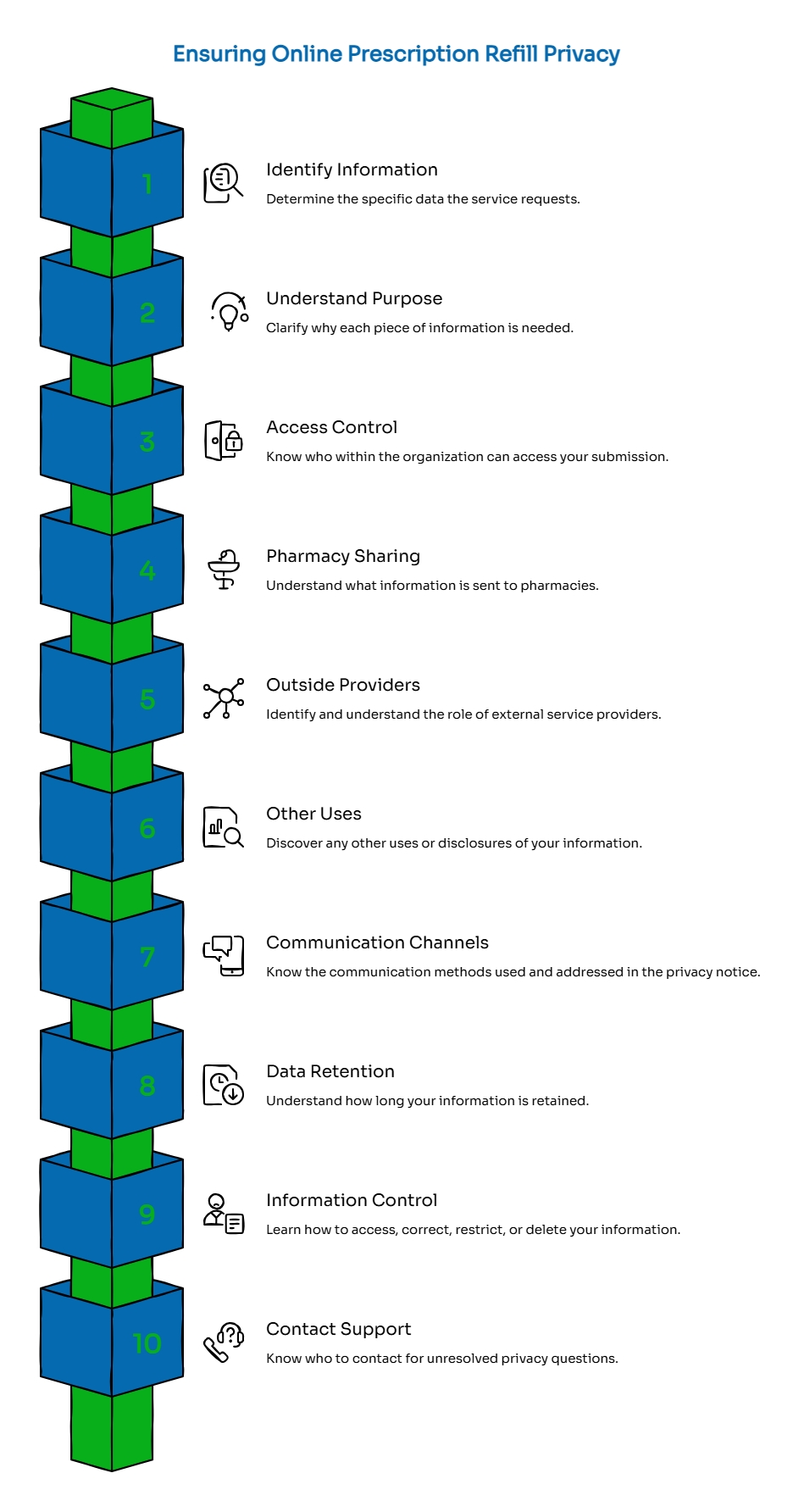
Use this checklist before completing an online refill form. The questions are answer-neutral: they help you evaluate what a service has disclosed, not what the answers should be.
-
What information is the service asking me to provide?
-
Why is each category of information needed for the refill review?
-
Who within the organization can access my submission?
-
What information may be sent to a pharmacy or other healthcare professional?
-
Are outside service providers involved, and does the privacy notice explain their role?
-
What other uses or disclosures does the privacy notice describe?
-
Which communication channels will be used, and does the privacy notice address them?
-
How long does the service retain my information after the request is complete?
-
How can I request access to, correction of, restriction on, or deletion of my information where applicable?
-
Who can I contact if I have an unresolved privacy question?
If a service answers these questions clearly, you have a stronger basis for deciding whether to proceed. If important answers are missing, consider reaching out before submitting sensitive information.
A Practical Standard, Not a Perfect One
Privacy evaluation does not require certainty. It requires enough information to make a considered choice. The questions above give you a structured way to check whether a service has explained its practices in terms you can understand and act on.
Before beginning a refill request, review the service’s current privacy notice and write down any questions it does not answer. If an important question remains unanswered, contact RefillGenie before submitting sensitive information.
The goal is informed participation: using a convenient service with your eyes open.
Frequently Asked Questions
What should I read before submitting an online refill request?
Start with the service’s current privacy notice and any consent or authorization language presented during intake. Look for sections that explain what information is collected, who can access it, how it may be shared, and how to raise a privacy concern. Reading these before you complete the form gives you the clearest picture of what you are agreeing to. Keep the relevant notice for reference so you can compare it with future updates or follow up on specific points.
Does “HIPAA-compliant” mean my information can never be shared?
A compliance-related statement should not be interpreted as an absolute promise that information will never be disclosed. For example, HIPAA rules apply to healthcare providers and their direct business associates, but they may not cover standalone tech platforms or consumer health apps. Privacy obligations and permitted disclosures can depend on the organization, the type of information, and the specific circumstances. If a service references compliance, check whether the privacy notice explains what protections apply and under what conditions information may be shared.
Who might receive information from an online refill request?
The answer depends on the service and its workflow. Potential recipients can include the reviewing clinician, a pharmacy, supporting technology or service providers, and any other parties described in the privacy notice. Ask the service to clarify who receives information and for what purpose rather than relying on a general statement alone.
Can I ask an online refill service to correct or delete my information?
Your right to modify or erase these details will be governed by the specific platform’s policies and the regional regulations regarding health data. Check the service’s current privacy notice for any description of access, correction, restriction, or deletion procedures. If the notice does not address these topics, contact the service directly. Identify the specific information and the action you want explained, and ask how the decision will be communicated to you.
Disclaimer: This article provides general educational information about questions readers may consider when evaluating privacy and information-sharing practices. It is not medical or legal advice and does not establish which privacy laws apply to a particular service or situation. Review the service’s current policies and consult an appropriately qualified professional if you need guidance about your rights, medication, or care.
Our Editorial Process:
Our content is developed to help readers understand common refill-gap situations, online refill boundaries, and temporary bridge-care options in plain language. We use Refill Genie source materials, service pages, FAQs, customer-feedback patterns, and relevant external authority sources to guide factual accuracy. Health-related content should be reviewed for clinical accuracy, eligibility language, safety limits, pricing, timing, and commercial terms before publication.
About the Refill Genie Insights Team
The Refill Genie Insights Team is our dedicated engine for synthesizing complex topics into clear, helpful guides. While our content is thoroughly reviewed for clarity and accuracy, it is for informational purposes and should not replace professional advice.