
September 18, 2026
Planning an Online Medication Refill: What Turnaround Times Really Mean

📌 Key Takeaways
Online refill estimates may cover only part of the process, leaving additional time between a clinician’s response and pharmacy pickup.
-
Sent Does Not Mean Ready: Pharmacies need their own processing time after receiving prescriptions, so a transmission confirmation does not mean pickup is ready.
-
Early Planning Creates Room: The author recommends starting before supplies run low, allowing time for follow-up questions and pharmacy processing.
-
Complete Details Reduce Delays: Accurate medication information and timely replies can reduce delays caused by missing details or unanswered clinician questions.
-
Fast Reviews Cannot Guarantee Approval: A clinician still needs to decide whether your medication and health situation fit the service.
-
Supply Concerns Need Professional Guidance: The author recommends contacting your prescribing clinician or pharmacist if delays threaten your supply, rather than changing medication use independently.
A refill estimate is only part of the timeline.
Adults managing existing prescriptions will better understand refill timing through the planning checklist and turnaround questions below.
You have a work trip next week, a prescription that needs refilling, and an online service promising a fast turnaround. The number on the screen looks reassuring. But does that estimate cover only the initial clinician response, or does it include everything through pharmacy pickup?
For anyone managing an existing medication on a busy schedule, the answer matters more than the number itself. Clinical review, eligibility decisions, prescription transmission, and pharmacy processing each operate on their own timeline. Planning well means understanding those stages before you need the medication, not after you have run out.
Start Before the Refill Becomes a Last-Minute Problem
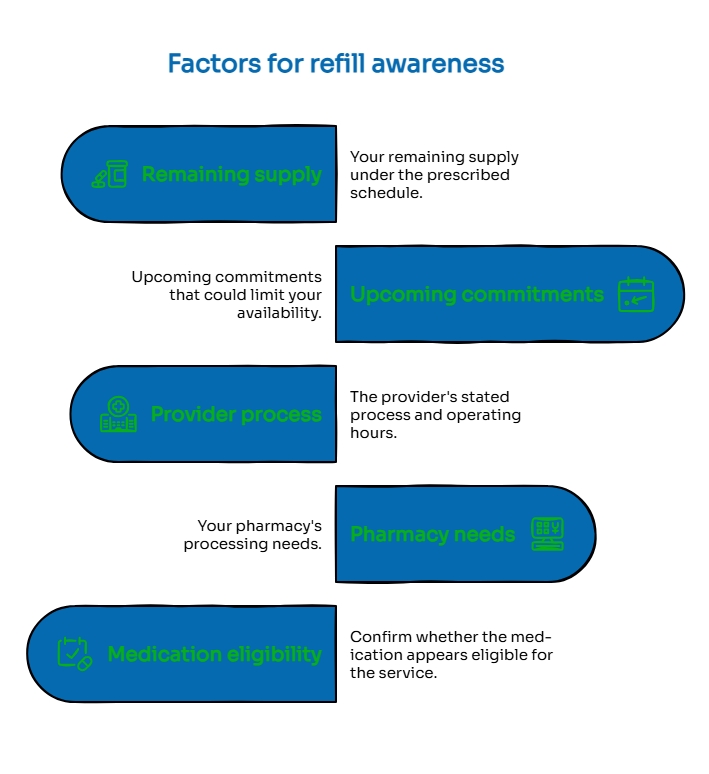
The safest strategy is also the simplest: begin before the situation feels urgent. Starting early gives you room to respond to clinician questions, handle eligibility issues, and account for pharmacy processing. When you wait until the last dose, every unexpected step compresses into a window that may not have room for it.
Starting early does not require a specific number of days. It requires awareness of five factors: your remaining supply under the prescribed schedule, upcoming commitments that could limit your availability, the provider’s stated process and operating hours, and your pharmacy’s processing needs. Check your current supply, confirm whether the medication appears eligible for the service you are considering, and gather the information the process is likely to need. Continue using the medication according to its existing directions while making that assessment. If you are planning a refill around travel or schedule changes, that preparation becomes even more important because you may have less flexibility to respond to follow-up questions once you are on the move.
What an Online Refill Turnaround Actually Covers
A turnaround estimate describes how long a process typically takes under certain conditions. It is not a guaranteed commitment to complete every stage within a fixed window. Most online refill services publish estimates, and understanding that distinction prevents planning around a promise the service may not have made.
In practice, the process involves several distinct stages, and the posted number may refer to only one of them.
A typical online refill process may include answering health questions, having your information reviewed by a licensed clinician, communicating with the care team via text message, and, when clinically appropriate, transmitting an electronic prescription to your pharmacy. Each step involves different people, different systems, and potentially different timing. The table below separates these stages.
| Stage | What Happens | Who Is Involved | What You Should Confirm |
|---|---|---|---|
| Request submission | You complete the intake form with your medication details, health history, and pharmacy information | You | That your information is complete and accurate |
| Clinician review and communication | A licensed clinician reviews your request and may contact you with follow-up questions | Clinician and you | Whether you need to respond to messages and how quickly |
| Prescription transmission | If the clinician determines a refill is appropriate, an electronic prescription is sent to your pharmacy | Clinician and prescribing system | That the prescription has been transmitted (this does not mean it is ready for pickup) |
| Pharmacy processing | Your pharmacy receives, reviews, fills, and prepares the prescription | Pharmacy staff | Readiness with your pharmacy directly, since processing times vary |
The critical distinction is the last row. Prescription transmission (the electronic delivery of a prescription from a clinician’s system to a pharmacy) and pharmacy fulfillment (the pharmacy’s process of receiving, verifying, filling, and preparing the medication for pickup) are not the same event. If you arrive expecting your medication immediately after a transmission confirmation, you may find it is still being processed. Confirm readiness directly with the pharmacy before making the trip.
When you see a turnaround estimate from any online prescription refill process, ask yourself which of these stages it covers. A number that describes clinician response time is useful, but it is not a promise that your medication will be in your hand by that point.
Factors That Can Change the Timeline
Some timing variables are within your control, and others are not. Understanding the difference helps you prepare for what you can manage and plan around what you cannot.
Factors you can influence:
Completeness of your submitted information is one of the most common sources of avoidable delay. If your medication name, dosage, prescribing history, or pharmacy details are missing or unclear, the clinician may need to follow up before the review can proceed. Preparing the records needed for an online refill request in advance can reduce that back-and-forth.
Your responsiveness to follow-up messages also matters. If the clinician asks a clarifying question by text and you do not see the message for several hours, those hours become part of your total wait. Keeping your communication channel accessible can prevent a gap that has nothing to do with the service’s processing speed. Imagine submitting a request right before a long meeting and then silencing your phone for the afternoon. The clinician sends a question, but the message sits unanswered until you check hours later. The pause happened because the clinical review needed missing information.
Factors outside your control:
Medication eligibility is typically finalized during the clinical review (the step where a licensed clinician evaluates your request, health history, and medication details to decide whether a refill is appropriate), even if an initial automated screening occurs during submission. For example, most online refill services cannot process prescriptions for controlled substances, complex injectables, or medications requiring regular lab monitoring.
The clinician’s review itself takes time, particularly if your health history requires careful evaluation. This is a clinical process, not an automated transaction. The service’s operating hours and business-day schedule may also affect when a review begins or when a clinician is available to respond, especially for requests submitted in the evening or on weekends.
Pharmacy processing operates independently from the online service. Staffing, prescription volume, inventory, and internal verification steps can all affect how quickly a transmitted prescription becomes ready. The online provider has no control over these variables once the prescription leaves their system, which is why treating a turnaround estimate as a fixed countdown can create a false sense of certainty. Depending on the pharmacy’s daily volume, filling an electronic prescription can take anywhere from an hour to a full business day.
Use a Backward-Planning Checklist
Rather than guessing how many days to allow, work backward from your situation. Each item below reduces a potential source of delay or uncertainty.
-
[ ] Check your remaining supply. Count what you have without changing how you take the medication. This gives you a planning window, not a reason to adjust your dose.
-
[ ] Map upcoming constraints. Note work obligations, travel dates, appointments, weekends, or other commitments that could limit when you can respond to a clinician or contact a pharmacy. These gaps affect your real timeline even when the service is moving quickly.
-
[ ] Confirm the request concerns an existing medication. Online refill services designed for maintenance prescriptions typically cannot start new medications or handle certain excluded categories.
-
[ ] Review current eligibility information. Before relying on a service’s timeline, check whether your medication is eligible through the provider’s current documentation.
-
[ ] Gather your medication details. Have the medication name, strength, current dosage instructions, prescribing history, and preferred pharmacy information ready before starting the intake form.
-
[ ] Check the service’s current turnaround language. Verify what the stated estimate actually measures. Does it refer to initial clinician contact, completed review, prescription transmission, or something else?
-
[ ] Keep the communication channel accessible. If the service communicates by text or app message, make sure you can receive and respond promptly.
-
[ ] Allow time for follow-up questions and pharmacy processing. Even if the clinical review moves quickly, your pharmacy will need its own processing time afterward. Build that into your planning.
-
[ ] Identify a backup contact. Know how to reach your prescribing clinician, pharmacist, or another licensed healthcare professional if the online request cannot be completed or takes longer than expected.
-
[ ] Avoid waiting for a crisis. Contact an appropriate healthcare professional rather than altering your medication use independently if your supply becomes a concern.
This checklist is a planning tool, not a clinical recommendation. It does not replace guidance from a licensed healthcare professional who knows your specific health situation.
What to Do if the Expected Timeline Slips
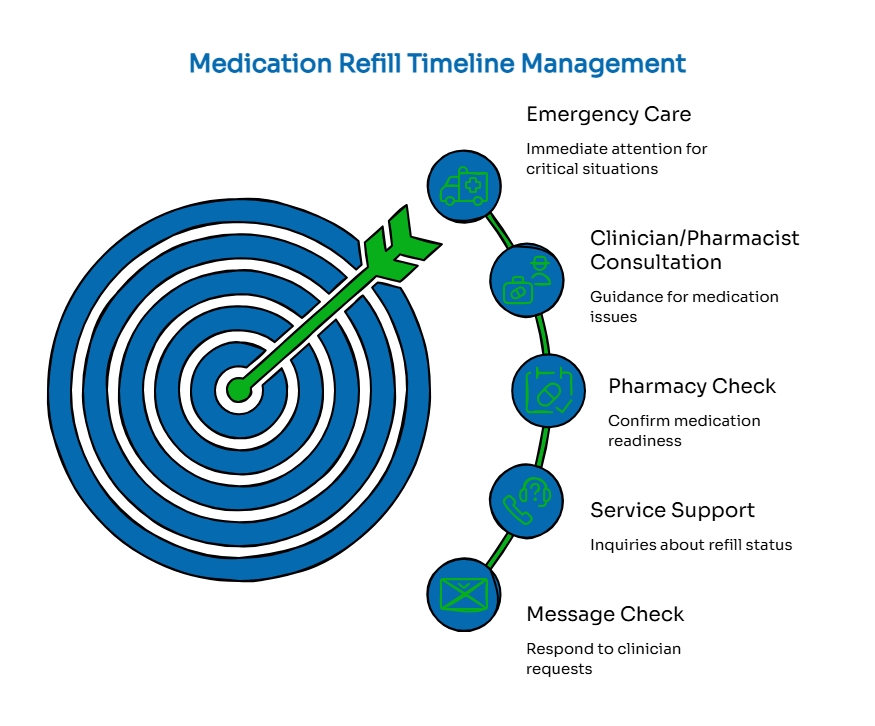
Even with careful preparation, the process may take longer than anticipated. Start by checking your messages. If the clinician or service has asked a follow-up question, responding quickly can get the process moving again. If you have not received any communication, use the service’s available support channel to ask a stage-specific question — whether the request is waiting for additional information from you, undergoing clinical review, awaiting a decision, or pending transmission.
Once you receive confirmation that a prescription has been transmitted, contact your pharmacy directly to check on readiness. Do not assume that transmission and dispensing happen simultaneously.
If you learn that the medication is not eligible for the online pathway, avoid resubmitting the same request. Instead, contact your prescribing clinician or pharmacist to discuss situation-specific options. This preserves the clinician’s determination and redirects your effort toward a professional resource that can actually help.
If the timeline extends beyond your remaining supply, contact your prescribing clinician or pharmacist for situation-specific guidance. They can advise on the safest course of action based on your medication and health history. Do not adjust, skip, or change how you take your medication without professional direction.
For any acute or life-threatening reactions, bypass the online service entirely and go straight to an emergency room or call 911**.** An online refill service is not a substitute for emergency treatment.
RefillGenie describes its service as a temporary bridge rather than a replacement for ongoing primary care. If you find yourself depending on any online refill service regularly, reconnecting with a local provider is an important next step.
Questions to Ask Before Relying on a Turnaround Claim
Before depending on any advertised timeline, ask these seven questions. They apply to any online refill service.
-
What event starts the clock? Is the turnaround measured from form submission, payment, initial clinician contact, or something else?
-
What event ends it? Does the estimate end at clinician response, completed review, prescription transmission, or pharmacy readiness?
-
Is it an estimate or a commitment? An estimate reflects typical experience under certain conditions. A commitment implies a service-level guarantee. The distinction matters when planning around limited supply.
-
Which conditions affect the estimate? Check whether operating hours matter, what happens when submitted information is incomplete, and whether additional clinician questions pause or extend the expected timeframe.
-
When is eligibility determined? Learn whether the medication is screened before submission, during clinical review, or through another stated process. Eligibility remains separate from how quickly information is reviewed.
-
What can require follow-up? If the clinician needs clarification or additional health information, does the stated timeframe account for that exchange?
-
Does it include pharmacy processing? If the estimate covers only the provider’s portion, your total wait includes whatever time your pharmacy needs after receiving the prescription.
A service that answers these questions transparently gives you a stronger foundation for planning.
Frequently Asked Questions
How far ahead should I request an online medication refill?
No universal interval applies. Check your remaining supply, review the provider’s current eligibility and turnaround information, and submit well before reaching a last-dose scenario. Clinician follow-up, eligibility review, and pharmacy processing can each add time that a headline turnaround number may not reflect. If travel or limited availability is approaching, include those constraints when judging how much planning room remains.
Does same-day refill service guarantee that my medication will be ready that day?
Not necessarily. “Same-day” may refer to different milestones depending on the provider: initial clinician contact, completed review, or prescription transmission. Pharmacy dispensing operates on a separate timeline. Before relying on a same-day claim, confirm which stage it describes and check with your pharmacy about processing time after receiving an electronic prescription.
What can delay an online refill request?
Common factors include incomplete intake information, unanswered follow-up messages from the reviewing clinician, medication eligibility questions, additional clinical evaluation, and pharmacy-side processing after the prescription is transmitted. Preparation can minimize some of these delays, but others (like eligibility determinations) are part of the clinical review process. When a delay occurs, identify whether the next action belongs to you, the clinician, the service, or the pharmacy.
What should I do if I may run out before the refill is completed?
Contact your prescribing clinician, pharmacist, or another licensed healthcare professional for guidance specific to your medication and health situation. Maintain your prescribed dosing schedule unless directly instructed otherwise by a healthcare professional. If you experience severe or life-threatening symptoms, contact emergency services or seek urgent medical care immediately. For additional details about how online refill services work, you can review online refill FAQs from specific providers.
A Realistic Plan Beats a Fast-Looking Promise
The goal is not to find the quickest number on a website. It is to understand the stages between submitting a request and picking up your medication, prepare the information that keeps the process moving, and leave enough room for the parts you cannot control.
Before submitting a refill request, confirm medication eligibility, review the provider’s current timing information, and prepare any questions for a licensed healthcare professional.
Disclaimer: This article is for general informational purposes only and does not constitute medical advice, diagnosis, or treatment. Readers should consult a licensed healthcare professional for guidance specific to their health, symptoms, medications, or treatment options.
Our Editorial Process:
Our content is developed to help readers understand common refill-gap situations, online refill boundaries, and temporary bridge-care options in plain language. We use Refill Genie source materials, service pages, FAQs, customer-feedback patterns, and relevant external authority sources to guide factual accuracy. Health-related content should be reviewed for clinical accuracy, eligibility language, safety limits, pricing, timing, and commercial terms before publication.
About the Refill Genie Insights Team
The Refill Genie Insights Team is our dedicated engine for synthesizing complex topics into clear, helpful guides. While our content is thoroughly reviewed for clarity and accuracy, it is for informational purposes and should not replace professional advice.