
September 4, 2026
Is an Online Refill Appropriate for Long-Term Medication Management? Factors to Consider

📌 Key Takeaways
An online refill may support an existing prescription when a clinician can assess your current health and medication details.
-
Refills Require Clinical Review: An existing prescription provides history, but a clinician must decide whether continuing the medication is appropriate now.
-
Refill Support Has Limits: A temporary refill may bridge a care gap, but it does not replace ongoing medication management.
-
Current Information Supports Review: The author recommends sharing current records and health changes so the clinician can assess the request.
-
Monitoring May Still Matter: Long-term medication use may still require tests or follow-up that a refill alone cannot replace.
-
Location Can Affect Access: Your physical location and the medications a service handles may limit whether an online refill can proceed.
An existing prescription starts the review, not an automatic refill.
People taking long-term medications will understand what may affect an online refill request through the five-factor guide below.
Taking a maintenance medication does not automatically make an online refill request appropriate or inappropriate. The term describes a medication already used as part of an ongoing treatment routine — it does not determine whether continuing it is suitable now. When work, travel, a care transition, or a delayed response from your regular office interrupts access, the useful question is whether an online clinician can responsibly assess an existing prescription using current information. If your usual prescriber is unavailable and a refill is coming due, the answer depends on more than the fact that a prescription already exists. Your medication’s current status, recent health picture, available records, outstanding monitoring needs, and location all play a role. An online refill review is also not the same as comprehensive, ongoing medication management.
The five-factor framework below can help you organize what matters before submitting a request and recognize when a different care pathway may be a better fit.
The Short Answer: An Online Refill May Fit A Routine Existing Prescription, But Clinical Review Still Matters
An online refill review may be a reasonable option when you need continued access to a medication you already take, your dose and directions have not changed, and you can provide current, accurate information. A clinician, not a checklist, determines whether a refill is appropriate after reviewing your submission.
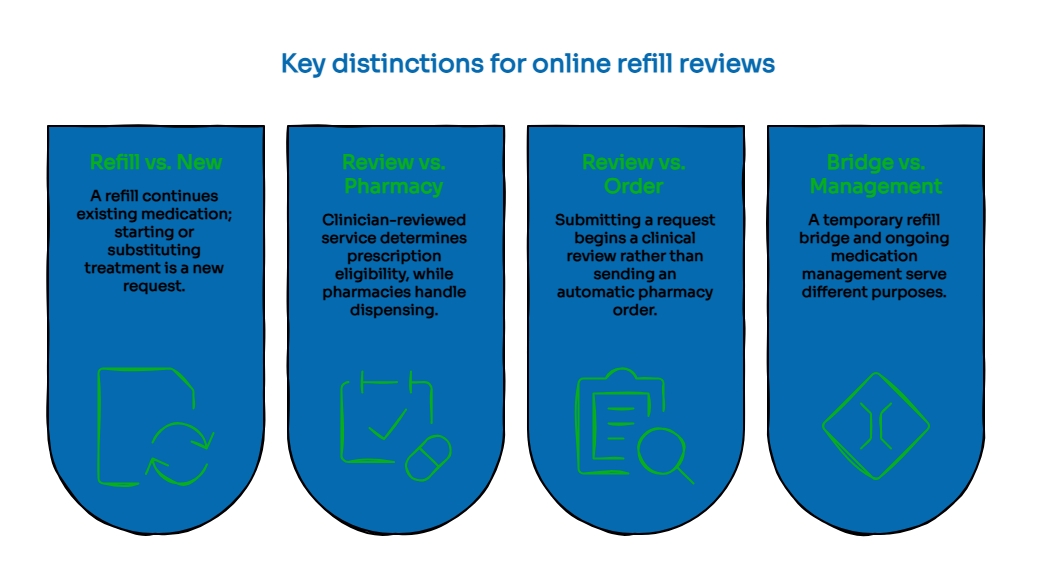
Four key distinctions are important to understand upfront. First, a refill continues medication that has already been prescribed; starting a medication or substituting another treatment is a new request, even when it addresses the same health concern. Second, a clinician-reviewed refill service is not the same as an online pharmacy: the review determines whether a prescription can be sent, while the pharmacy handles dispensing. Third, submitting a request begins a clinical review — it does not send an automatic order to a pharmacy. A doctor evaluates the submitted medical information and, when appropriate, transmits a prescription to the patient’s local pharmacy. Fourth, a temporary refill bridge and ongoing medication management serve different purposes, a distinction explored in detail below.
For those with managed health profiles, our related guide on online refill eligibility for stable chronic conditions offers additional context.
The Five-Factor Online Refill Fit Check
| Factor | What may support a routine refill review | What should be disclosed for broader clinician assessment |
|---|---|---|
| 1. Prescription status | Medication is already prescribed to you | Request would start a medication or substitute a different one |
| 2. Current routine | Current strength and directions are clear and unchanged | Dose, directions, symptoms, side effects, diagnoses, or other treatment details have changed |
| 3. Information available | Current label or medication list, history, prescriber, and pharmacy details are accessible | Records conflict, are missing, or show older instructions |
| 4. Follow-up needs | No known unresolved monitoring question is being omitted | Bloodwork, examination, or other follow-up may be due or unclear |
| 5. Service fit | Patient location and medication are within the provider’s current scope | Location, medication category, or clinician judgment prevents online handling |
This is a preparation aid, not an eligibility test. Only a licensed clinician can decide whether a refill is appropriate for a particular person and medication.
Five Factors That Can Shape An Online Refill Review
1. Is this an existing prescription or a new treatment request?
The fact that a medication was prescribed before gives the reviewer important history. It does not establish that the previous decision applies without reconsidering current circumstances. A refill request generally concerns an existing medication rather than a new diagnosis or a medication that has not previously been prescribed. If you need a prescription for a new medication or want to switch treatments, the request falls outside a standard refill pathway. New medications involve clinical decisions — dosing, interactions, contraindications — that require a more comprehensive evaluation.
Consider someone who takes the same medication at the same strength with the same directions, has a current bottle and an up-to-date medication list, and has no unresolved health changes. Those details may help a clinician recognize the request as a continuation rather than treatment initiation, but they cannot predict the result. A request to begin a medication, replace it, or develop a new treatment plan calls for a different type of assessment.
2. Has the medication routine or health picture changed?
In this article, a stable routine means only that the reported strength and directions are current and unchanged. It is not a medical classification, and it does not mean that monitoring or regular follow-up is unnecessary. An existing prescription remains only one part of the review.
If your dose or directions have recently changed, if you have experienced new symptoms or side effects, or if you have received a new diagnosis, the request may involve considerations beyond a routine refill. Tell the clinician about changes to the dose or directions, new symptoms or side effects, a new diagnosis, recent hospital care, pregnancy when relevant, or medications added to your treatment (typically within the last 30 to 90 days). These changes do not automatically disqualify a request, but they are details a reviewing clinician needs to assess whether proceeding is appropriate. Share what has changed rather than trying to classify the significance yourself.
If your bottle label shows older directions that no longer match your current plan, provide both the label and the newer information. Do not decide privately which version should control. Disclose the discrepancy so the clinician can evaluate it. For more on navigating this situation, see what to check when your dose or schedule has changed.
3. Are the medication details and records current?
An online clinician may not automatically see records kept by another practice, hospital, or healthcare system. A clinician reviewing your request remotely needs you to supply what they cannot retrieve on their own. Vague or conflicting information can make it difficult to determine what was prescribed, how current directions were established, and what has changed since your last review.
FDA guidance recommends maintaining an updated medication list with each medication’s name, strength, purpose, and directions. HHS telehealth preparation guidance also lists current medications or bottles, medical history, symptoms or concerns, and pharmacy contact information among details that may be requested.
Gathering this information in advance can make review smoother. Accurate records reduce avoidable uncertainty without determining the clinical outcome. For a deeper look, see records to gather before an online refill request.
4. Does the medication require monitoring or follow-up?
Long-term use does not remove the possibility of monitoring. Some medications or circumstances call for periodic bloodwork, lab tests, physical examinations, or other follow-up. When monitoring is overdue or unclear, a refill alone may not address the broader clinical picture.
Certain medications may not be appropriate for a routine refill pathway, including controlled substances and medications that require close monitoring of blood levels (such as specific stimulants for ADHD, certain anxiety medications, or opioid pain relievers). In some cases, a clinician may recommend bloodwork or other follow-up before providing a refill. If you are unsure whether your medication involves outstanding monitoring needs, that uncertainty is itself worth mentioning when you submit your information. Disclose overdue, uncertain, or requested follow-up instead of treating the refill as a replacement for it.
5. Do patient location, provider scope, and clinical judgment align?
Online access does not eliminate geographic or professional limits. HHS notes that the ability to deliver healthcare across state lines varies based on state regulation. If you are traveling or temporarily in another state, access to an online refill review may differ from what is available at home. Someone temporarily staying in another state should not assume that access follows automatically from their home location. Additionally, your health insurance or preferred pharmacy network may have restrictions on out-of-state prescription coverage. Requirements and availability can depend on the medication, the circumstances, and the patient’s physical location during care.
Beyond location, the reviewing clinician exercises independent professional judgment. Even when a request appears routine on paper, the clinician may identify a reason to redirect you to a different care setting.
Why An Online Refill Request May Not Move Forward
Not every request results in a prescription being sent. The reasons below are an explanatory set of common factors, not a complete description of any one service’s review policy. Understanding them can reduce frustration and help you plan next steps.
A request may not move forward when it involves a new medication or treatment change, when submitted information is incomplete or conflicting, or when recent changes in symptoms, side effects, or treatment details signal that a broader evaluation is needed. Unaddressed monitoring or follow-up needs can also affect the outcome. Medications outside a service’s scope (such as controlled substances or those requiring close lab monitoring) may not be eligible regardless of other factors. Patient location and provider licensure can create limitations if the provider is not authorized to prescribe in your current state. In some cases, the reviewing clinician may determine, based on the full picture, that a different type of assessment is the appropriate next step.
None of these reasons necessarily means something is wrong with your health. They reflect the boundaries of what a remote refill review can responsibly accomplish. Submitting complete, current information supports the review process, but it does not guarantee approval. Trying to make a request appear routine by leaving out changes can remove information the reviewer needs. Describe the current situation plainly, including uncertainty.
Online Refill Support Is Not Long-Term Medication Management
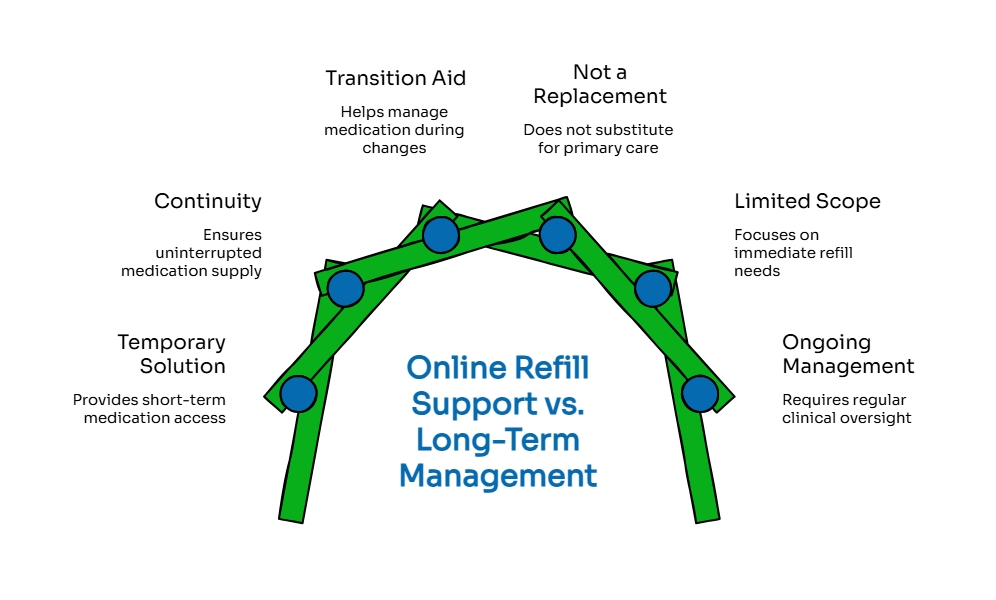
A refill bridge and ongoing medication management serve different purposes.
Many telehealth refill platforms describe their services as temporary resources to bridge gaps in care, not replacements for a primary care provider. They typically encourage users to re-establish care with a local provider for regular physical exams and long-term health management. A refill review addresses continuity during a temporary access gap, while longitudinal management may include periodic assessment, medication reconciliation, treatment adjustments, preventive care, and condition-specific follow-up. That broader work gives a healthcare professional opportunities to compare information over time and address needs beyond the immediate refill request.
Using an online refill pathway during a transition — between providers, insurance plans, or while traveling — can be practical when the circumstances fit. That does not mean online care can never play a role in a broader healthcare relationship, but relying on a refill bridge as a substitute for an ongoing clinical relationship means that the monitoring, reassessment, and broader decisions medications require may go unaddressed. Receiving one refill neither transfers long-term management to the refill service nor establishes that a later request will have the same outcome. A refill bridge helps maintain continuity while you re-establish regular care.
What To Prepare Before Requesting An Online Refill Review
Gathering accurate information in advance helps a clinician review your request with fewer questions. Based on HHS telehealth preparation guidance and FDA medication-list recommendations, consider assembling the following:
-
Current medication name, strength, and directions
-
Reason the medication was prescribed
-
Your medication bottle or label
-
Name of the prescriber who originally wrote the prescription
-
Pharmacy name and contact information
-
Relevant medical history
-
Known allergies and other current medications or supplements
-
A brief note about any recent changes, new symptoms, side effects, tests, or questions
If the bottle, medication list, or other record shows older instructions, include it and explain the discrepancy. Do not alter information to make the request seem simpler. Not every provider requires every item, and having everything prepared does not guarantee approval. It does give the reviewing clinician the clearest possible picture of your situation.
If you are ready to see whether your medication may be eligible, you can check whether your medication is eligible. Eligibility information and a clinician’s review, not this article, determine what can proceed.
When The Situation No Longer Looks Routine
Some circumstances call for a different kind of attention than a refill review can provide. If you are looking to start a new medication, have significant new or worsening symptoms, are unsure which dose or directions are current, or have an unresolved monitoring question, contacting a licensed healthcare professional who can assess your full circumstances is the safer path. Provide a full accounting of any new developments, leaving the medical evaluation of those details to the provider.
For severe or life-threatening symptoms, call 911 or seek immediate emergency care. An online refill request is not an emergency-response pathway and should not delay immediate help.
A refill bridge works best when it supports continuity for an established, routine prescription. When the situation moves beyond that scope, the responsible next step is a clinician who can evaluate the complete picture.
Frequently Asked Questions
Does having an existing prescription guarantee an online refill?
No. An existing prescription confirms that the medication was prescribed previously, but the reviewing clinician also considers the information you provide, monitoring needs, current circumstances, service scope, your location, and their own professional judgment.
What if my dose or directions recently changed?
Tell the reviewing clinician and provide the most current records you have. Do not try to determine on your own which instructions should apply. A recent change may mean additional information is needed before proceeding.
Disclaimer: This article is for general informational purposes only and does not constitute medical advice, diagnosis, or treatment. Readers should consult a licensed healthcare professional for guidance specific to their health, symptoms, medications, or treatment options.
Our Editorial Process:
Our content is developed to help readers understand common refill-gap situations, online refill boundaries, and temporary bridge-care options in plain language. We use Refill Genie source materials, service pages, FAQs, customer-feedback patterns, and relevant external authority sources to guide factual accuracy. Health-related content should be reviewed for clinical accuracy, eligibility language, safety limits, pricing, timing, and commercial terms before publication.
About the Refill Genie Insights Team
The Refill Genie Insights Team is our dedicated engine for synthesizing complex topics into clear, helpful guides. While our content is thoroughly reviewed for clarity and accuracy, it is for informational purposes and should not replace professional advice.