
August 14, 2026
How New Symptoms or Side Effects Can Affect an Online Prescription Refill Review

📌 Key Takeaways
The author recommends clearly reporting every new symptom or medication change so a licensed clinician can judge the refill request.
-
Report Facts, Not Causes: The author recommends describing what changed and when, while letting the clinician decide what caused it.
-
Build One Clear Timeline: Include dose changes, missed doses, new products, symptom patterns, and any conflicting directions or records.
-
Changes May Shift Review: New symptoms do not guarantee denial, but clinicians may need questions, records, monitoring, or different care.
-
Never Hide Uncertainty: The author recommends stating what you know, noting gaps honestly, and correcting mistakes instead of guessing.
-
Know Refill Limits: Refill-only services may not handle new or urgent conditions, and a clinician may recommend another care option.
Clear facts support safer, more responsible refill reviews.
People refilling existing prescriptions online will prepare stronger updates with the symptom-reporting checklist that follows.
A fact-based way to describe what changed, prepare for clinical review, and avoid turning uncertainty into self-diagnosis.
You have taken the medication before. The name is familiar, the routine is set, and the refill feels like a formality. Then something changes—a symptom you have not noticed before, a reaction that was not there last time, or a shift in how you feel since the prescription started.
That change does not have a single, automatic answer. It does not guarantee a denial, and it does not mean the request will move forward without questions. A licensed clinician reviews the individual’s current information and determines the appropriate next step. This article helps you document those changes, understand why the review may differ this time, and avoid shortcuts that can slow the process down.
Three terms used throughout deserve brief explanation. A routine refill review occurs when your health situation and medication use have not changed since the last prescription—the clinician confirms the details and decides whether to renew. An existing medication is one already prescribed to you by a licensed provider, not a new prescription. A suspected side effect is any new or changed symptom you believe may be connected to your medication—described as an observation, not a confirmed cause.
Why A Changed Health Situation Can Make A Refill Less Routine
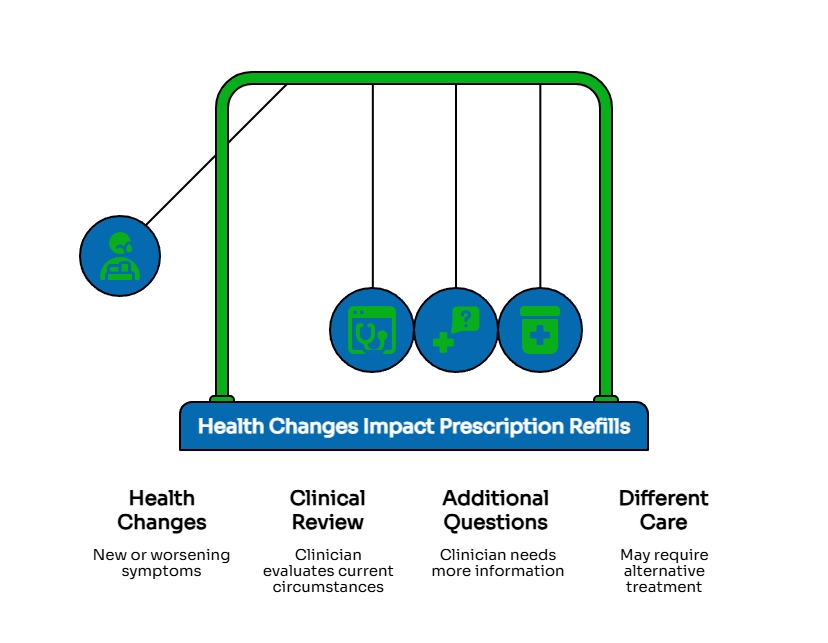
A prescription refill for an existing medication may seem administrative, but the review behind it is clinical. The clinician is not only confirming that you have taken the medication before—they are evaluating whether your current circumstances still support renewing it.
When nothing has changed, that evaluation can be straightforward. When something has changed, the clinician may need to understand what happened, when it started, and whether the situation calls for additional questions, records, monitoring, or a different type of care.
Several kinds of changes can shift the review. New or worsening symptoms give the clinician information that was not part of the previous decision. A change in how you take the medication, a recently added over-the-counter (OTC) product or supplement, or a gap in doses may also matter. Even a shift in the condition the medication was originally prescribed for can make the request less routine.
None of these changes predetermines the outcome. They mean the clinician has more to weigh. If the underlying condition no longer feels as stable as before, include that change in your update using your own words—a licensed clinician may need to clarify the pattern, review records, or discuss a different next step. For the unchanged counterpart, online refill eligibility when a chronic condition is stable offers related reading rather than medical evidence.
Your Role Versus The Clinician’s Role
The core distinction is between reporting what you observed and drawing your own conclusion about what caused it. The table below makes that boundary concrete.
| Your role: report what you observed | The clinician’s role: evaluate and decide |
|---|---|
| Describe the new or changed symptom in your own words | Determine whether the symptom may be related to the medication, another factor, or a combination |
| Note when it started, whether it comes and goes, and how it has changed | Assess whether the timeline and pattern affect the refill decision |
| List any recent changes to dose, schedule, or how you take the medication | Decide whether those changes require further review, monitoring, or a different care path |
| Share other products recently started, stopped, or changed | Evaluate whether the full medication picture affects the request |
| Provide available records, lab results, or prior instructions | Weigh the documented history alongside your current report |
Neither column guarantees a specific outcome. Together, they support a responsible review.
Observation Versus Interpretation: Examples
Even when you suspect a connection, the most useful thing you can provide is a clear observation—not a verdict. The hypothetical examples below show the difference between a fact worth recording and a conclusion that belongs to the clinician.
| Observation to report | Interpretation to leave to the clinician |
|---|---|
| ”The change began last week and has come and gone." | "The medication definitely caused it." |
| "My bottle and a newer message show different directions." | "I decided which directions must be right." |
| "I recently added an over-the-counter product." | "The products must be interacting.” |
Recording the observation keeps the information useful. Stating the interpretation replaces clinical judgment with a guess.
Use The “What Has Changed?” Checklist Before You Submit
The most useful thing you can do before requesting a refill is organize the facts. The checklist below helps you prepare a concise, accurate update without diagnosing yourself or guessing what caused a symptom. A licensed clinician evaluates that information—your job is to report it clearly.
Report what you observed; do not try to prove what caused it.
1. Medication name, strength, and current directions. Copy the exact name, dose, and instructions from your most recent label or records. If your directions changed after the label was printed, note both what the label says and what you were most recently told. For example, a hypothetical reader might find that the bottle still shows the original twice-daily schedule, while a provider later instructed once-daily use—recording both versions and any supporting documentation helps the clinician see the full picture. For more detail on handling that kind of mismatch, see what to check when your dose or schedule has changed.
2. What feels new, different, or worse. Describe the change in your own words. You do not need medical terminology—plain language such as “a headache that was not there before” or “stomach discomfort that started two weeks ago” is specific enough to be useful. Name only what you noticed, and avoid assigning a diagnosis, severity category, or cause.
3. When it began and how it has behaved. Note the approximate start date, whether the change is constant or comes and goes, and whether it has improved, worsened, or stayed the same over time. A hypothetical reader who noticed an intermittent symptom during a busy work week would record the first date they noticed it and whether it appeared at a consistent time of day—without deciding whether the medication caused it. If you cannot recall the exact date, give an accurate range; “I am not sure of the exact day” is better than invented precision.
4. Any recent change in dose, schedule, or how you take the medication. If you missed doses, changed when you take the medication, split or crushed a tablet, or made any other adjustment, record that as a fact. Do not include a judgment about whether the change was appropriate—state what happened and when.
5. Other prescription medicines, OTC products, or supplements recently started, stopped, or changed. List anything you have added, removed, or adjusted in the time surrounding the new symptom. Include the name, approximate date of the change, and how you are currently using the product. A hypothetical reader who recently started a daily vitamin supplement would note the product name, when they began taking it, and the current dose—then let the clinician determine whether it may be relevant. Treat the list as a timeline of facts; do not claim an interaction or identify one product as the cause.
6. Records, prior instructions, or monitoring results available to share. Gather any recent lab results, specialist notes, pharmacy summaries, or written instructions from a provider. If you do not have everything, note what you do have and what is missing. Keep conflicting records together so the difference is visible. For a fuller guide on preparing documentation, see records to gather before an online refill request.
7. Questions you want the clinician to answer. Write down anything you are unsure about. Preparing questions in advance helps you use the review time well and ensures nothing important is forgotten.
What A Clinician May Need To Clarify
Even with a thorough checklist, the reviewing clinician may follow up—that is part of responsible review, not a sign of trouble.
Follow-up may involve a clearer timeline, more detail about current medication use, confirmation of other prescriptions or products, or access to records. In some situations, the clinician may determine that the request needs monitoring, additional information, or a type of care that goes beyond a refill review. If you are unsure about a follow-up question, say so; a qualified uncertainty is more accurate than a confident guess.
Refill Genie’s service page states that its clinicians review health information submitted by the user and contact them by text. If appropriate, an electronic prescription for an existing medicine may be sent to the user’s pharmacy. The service’s scope is strictly limited to renewing existing prescriptions and excludes the evaluation of new, urgent medical issues, and that certain medications cannot be refilled. In some cases, monitoring or bloodwork may be needed before a refill can proceed.
These boundaries exist because a refill-only review has limits. When the situation falls outside those limits, the clinician may guide you toward a different next step—and that guidance depends on having accurate, complete information from you.
What Not To Do While Seeking A Refill Review
Do not hide a change to keep the process simple. Omitting a new symptom or a medication adjustment may seem like a shortcut, but incomplete information limits what a clinician can responsibly assess. If a detail feels uncertain, include it and let the clinician determine whether it matters. Clear reporting is neither an admission nor a prediction—it is the foundation of a useful review.
Do not try to diagnose the cause yourself. You may suspect the medication is responsible, or you may feel confident that the symptom is unrelated. Either way, describe what you noticed and when—not your conclusion about why it happened. A change that appeared after a medication, dose, schedule, or product adjustment is worth recording, but sequence alone does not establish causation. If another clinician has already given you an interpretation, identify that source rather than presenting the conclusion as your own diagnosis.
Do not rely on an outdated label as the full picture. If your directions, dose, or prescriber have changed since the label was printed, the label alone may not reflect your current situation. Include the most recent information you have, even if it comes from memory or a separate communication, and make the mismatch visible so the reviewer can sort it out.
Do not use this article to adjust, skip, or stop a medication. Nothing here constitutes individualized medication instructions. If you have questions about how to take your medication while awaiting review, contact a licensed clinician or pharmacist directly.
A refill review is not a diagnosis of a new acute condition. If your situation involves a new, urgent, or worsening problem that may need immediate attention, a refill-only review may not be the appropriate next step. The reviewing clinician determines whether the request fits within the scope of a refill review or whether a different level of care is needed. If the clinician determines a refill cannot be safely approved online, they will typically direct you to schedule an in-person or live telehealth visit with a primary care provider to evaluate the new symptom.
Prepare A Concise Update And Stay Available For Follow-Up
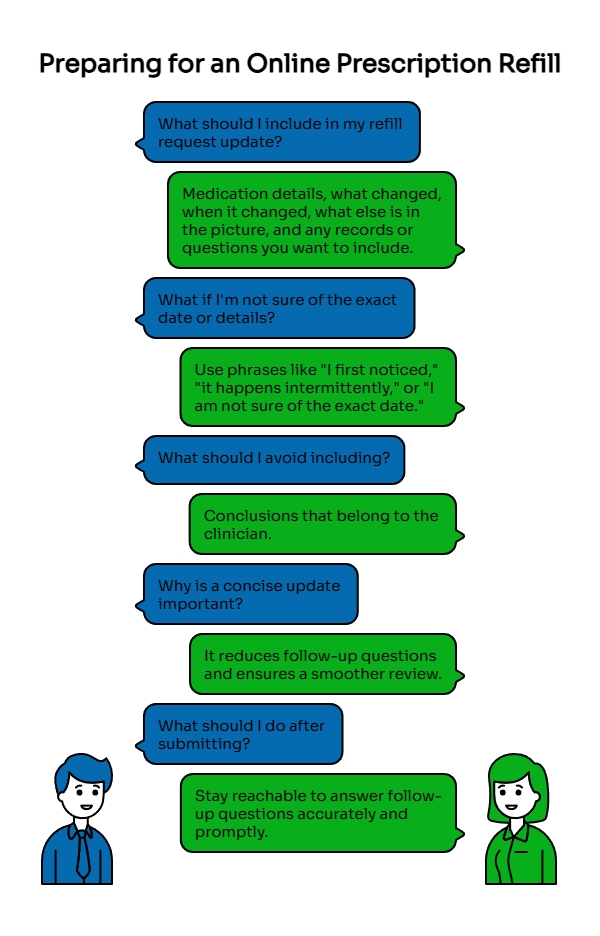
Before submitting a refill request, pull together the checklist items into a single note. Keep it factual and organized: medication details first, then what changed, when it changed, what else is in the picture, and what records or questions you want to include. If you need help fitting this into a busy schedule, see how to prepare for an online refill during a workday.
Clarity does not require false certainty. Use phrases such as “I first noticed,” “it happens intermittently,” or “I am not sure of the exact date” when they match what you know. If you later remember a relevant fact or find an entry error, correct the record instead of forcing every detail into a perfectly consistent story.
A concise update reduces the chance of follow-up questions that could have been answered upfront. Before submitting, scan the note for conclusions that belong to the clinician and replace them with observations. Confirm that label information is copied accurately, differences are visible, and supporting material is easy to locate. Then stay reachable after submitting—a text-based review depends on your availability to answer follow-up questions accurately and promptly.
Refill Genie describes its service as a temporary bridge for existing-medication refill requests—not a replacement for ongoing primary care. If the clinician determines that your situation needs a different level of assessment, that recommendation is part of responsible care.
A Complete Update Supports A Responsible Review
Accurate disclosure does not determine an outcome, but it gives the clinician a clearer basis for responsible review. The checklist helps you turn uncertainty into organized facts: the medication details, what changed, the timeline, related products, records, and your questions. Your role is to report that information without hiding changes or overstating conclusions; the licensed clinician’s role is to clarify what is missing and decide what is appropriate for your circumstances. That division keeps the update useful without turning it into self-diagnosis.
Learn how Refill Genie reviews existing-medication refill requests.
Frequently Asked Questions
Do new symptoms or side effects automatically make an online refill request ineligible?
There is no universal automatic outcome. A new or changed symptom gives the reviewing clinician additional information to consider, and the appropriate next step depends on individual circumstances. The clinician determines whether a refill, further questions, monitoring, or a different care path is needed.
What information should I include about a new symptom or suspected side effect?
Describe what changed, when it started, and whether it is constant or intermittent. Include your medication name, strength, and directions, any recent changes to dose or schedule, other products recently started or stopped, and available records. Report observations, not conclusions about causation.
Should I decide whether my medication caused the symptom before requesting a refill?
No. Describe what you noticed and provide an accurate timeline. Record the sequence without claiming causation. A licensed clinician evaluates whether the medication, another factor, or a combination may be involved.
Can a refill-only online service diagnose a new acute condition?
Refill Genie states that it does not diagnose acute conditions or start new medications. A refill review is designed for existing-medication requests and has defined limits. If the situation falls outside those limits, the reviewing clinician may recommend a different type of care.
Disclaimer: This article is for general educational purposes only and is not medical advice. It does not diagnose symptoms or determine whether a prescription refill is appropriate. A licensed clinician must review your individual circumstances. If you believe you may be experiencing a medical emergency, call 911 or seek emergency care.
Our Editorial Process:
Our content is developed to help readers understand common refill-gap situations, online refill boundaries, and temporary bridge-care options in plain language. We use Refill Genie source materials, service pages, FAQs, customer-feedback patterns, and relevant external authority sources to guide factual accuracy. Health-related content should be reviewed for clinical accuracy, eligibility language, safety limits, pricing, timing, and commercial terms before publication.
About the Refill Genie Insights Team
The Refill Genie Insights Team is our dedicated engine for synthesizing complex topics into clear, helpful guides. While our content is thoroughly reviewed for clarity and accuracy, it is for informational purposes and should not replace professional advice.