
October 9, 2026
Established Prozac Refills: Why Clinical Review Matters Before a Prescription Runs Out

📌 Key Takeaways
Every established Prozac renewal requires a clinician’s review of current information, even when your treatment has stayed steady.
-
Renewal Is Never Automatic: A clinician decides whether another prescription is appropriate today; a previous prescription does not guarantee approval.
-
Current Details Support Review: The author recommends sharing accurate prescription details, actual medication use, other medicines, and any health changes.
-
Review and Pickup Differ: A clinician’s response, a prescribing decision, and pharmacy pickup follow separate timelines, so response speed cannot predict pickup readiness.
-
Early Planning Leaves Room: The author recommends preparing before supplies run low because questions and pharmacy processing can add time.
-
Regular Care Still Matters: A refill review may bridge a temporary gap, while your regular prescriber handles broader treatment questions and changes.
Established treatment gives context; current review decides renewal.
Busy professionals already taking Prozac will better understand renewal decisions and preparation through the clinical review guide below.
The bottle rattles a little too lightly.
It’s 6:20 p.m., and you’re standing at the kitchen counter with your work bag still on your shoulder. You tip the Prozac bottle into your palm and count. Eleven capsules. On the calendar by the fridge, next week is already crowded with a client review, a two-day trip and a dentist appointment you’ve moved twice. There’s no free hour to call the prescriber this week.
You’ve taken Prozac long enough that the routine runs on its own. While the medication isn’t the problem, your calendar is. As your supply and schedule drift out of step, it isn’t clear whether an existing prescription means the next refill will simply go through.
It won’t simply go through, and that’s worth understanding before the bottle gets any lighter. An established Prozac refill renews a medication you already take rather than starting treatment for the first time, and each renewal is still a new prescribing decision. A licensed clinician reviews your current information and decides whether another prescription is appropriate today. When your usual prescriber is hard to reach, that review can work as a temporary bridge in established care. Preparing well supports the review, but it doesn’t replace it or guarantee the outcome.
Once you know what that review involves, the vague worry becomes a short list of things you can prepare this week. You’ll also have a realistic picture of which steps belong to you and which belong to a clinician.
If you already take Prozac, read on. Starting the medication, seeking a diagnosis or changing your treatment are separate decisions that belong with your own clinician.
The Refill Problem Often Starts Before the Bottle Is Empty
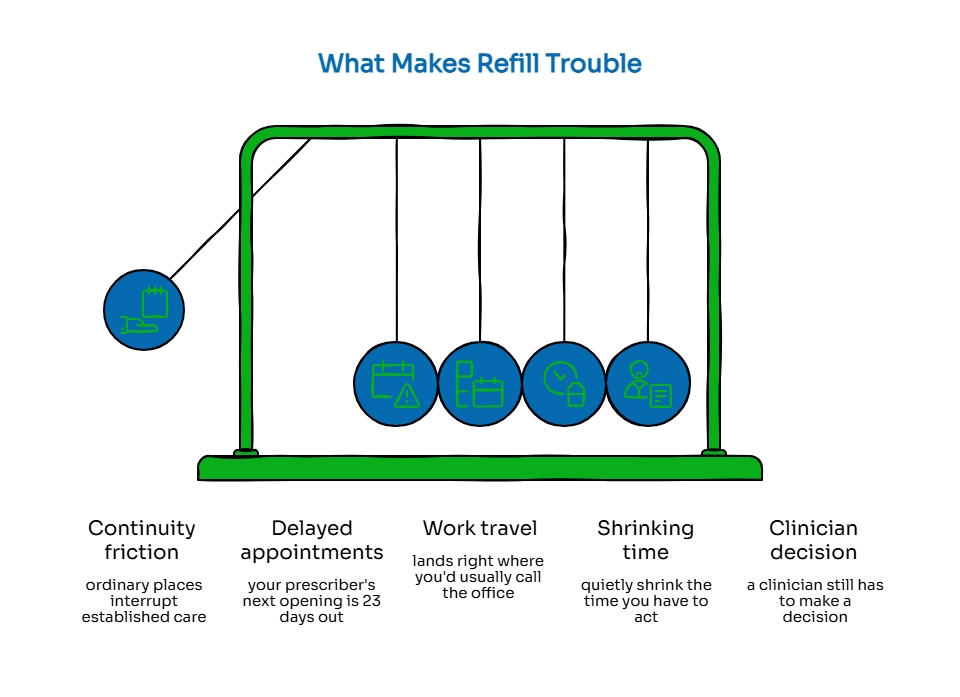
Most refill trouble isn’t about speed. It’s about continuity: keeping established care steady while a full calendar pulls in other directions.
The friction tends to come from ordinary places. A quarterly planning week fills every afternoon. A work trip lands right where you’d usually call the office. Your prescriber’s next opening is 23 days out, or the practice changes its scheduling system and your usual appointment disappears.
Customer reviews collected by Refill Genie describe exactly these interruptions: work travel, delayed appointments, moves and physician changes. One customer described an appointment delay during a switch to a new provider. Another, Mary C., wrote in a Google review that frequent work travel makes the service a way to bridge the gap until the next appointment.
Those are individual accounts, not measured trends. They still show the shape of the problem clearly.
Small habits make it worse. Many people don’t count their remaining doses until the bottle sounds nearly empty. Others work from an old label that no longer matches their current directions. Neither is a character flaw. Both quietly shrink the time you have to act.
The most common misreading is the belief that a faster request solves everything. Speed helps with one step. It doesn’t change the fact that a clinician still has to make a decision, and that decision depends on the information you bring.
Why an Established Prozac Prescription Still Needs Clinical Review
A previous prescription shows that Prozac was appropriate for you then. Rather than simply rubber-stamping the request, the process evaluates your current health status to ensure the medication remains the right fit.
This is the point many patients find surprising. Established treatment is not the same as an automatic prescribing decision.
Prozac is the brand name for fluoxetine, a selective serotonin reuptake inhibitor (SSRI). The U.S. National Library of Medicine’s MedlinePlus information on fluoxetine lists uses that include depression, obsessive-compulsive disorder, panic disorder and certain eating disorders, along with precautions, side effects and interactions that clinicians weigh. Your history with the medication gives a reviewer useful context. It doesn’t settle the next decision.
Think about what has happened since your last fill. You may have started another medication or a supplement. Your health may have changed. You may be taking Prozac a little differently than the label says. The clinician who signs a new prescription takes responsibility for that decision as of today, so they need today’s facts rather than last year’s.
Even “nothing has changed” is information the clinician must evaluate. The National Institute of Mental Health’s guidance on mental health medications stresses that treatment plans should reflect each person’s circumstances, so a reviewer still decides whether what you’ve shared is enough.
Refill Genie’s own materials draw the same line. The company’s Prozac refill service information separates starting Prozac from refilling an established prescription. Its published policies state that the service renews existing medications rather than starting new ones or diagnosing new conditions.
The company also notes that not every medication qualifies for online renewal. Certain medications that require ongoing monitoring are excluded, and a clinician may request additional bloodwork in individual cases.
Put simply, an established fluoxetine refill is a clinician-reviewed prescription renewal, not a reorder button. When the request is appropriate, that review is what makes continuity of established care possible. When it isn’t, the review is what catches the problem.
What a Clinician May Need to Verify Before Renewal
Accurate information matters more than polished information. A short, honest answer is more useful to a reviewing clinician than a long, guessed one.
The details usually fall into a handful of categories:
-
Your current prescription. The medication name, strength and directions as printed on your most recent label.
-
How you actually take it. A gap between the label and your real routine is clinically meaningful information, not something to smooth over. If a later appointment changed your directions and the bottle still shows the old ones, point out the difference rather than copying the label.
-
Everything else you take. This includes prescription drugs, over-the-counter products and supplements.
That last category deserves emphasis. MedlinePlus guidance on fluoxetine notes that some medications, along with certain nonprescription and herbal products, may interact with fluoxetine. A complete list gives the clinician what they need to make that judgment.
Relevant health history and anything that has changed since your last prescription round out the picture. New diagnoses, new side effects or a shift in how you’ve been feeling all belong here.
These categories describe what’s generally relevant to a renewal. They are not a scoring system or a published eligibility checklist. Two people with the same prescription can receive different decisions because their circumstances differ. For the same reason, don’t filter what you share to ease approval. Deciding what’s clinically relevant is the clinician’s job, and describing your situation accurately is yours. The guide on what health information may be needed before a refill is reviewed walks through these categories for refills in general.
Why Waiting Until the Bottle Is Nearly Empty Creates Avoidable Uncertainty
Picture the next morning. It’s 8:05 a.m. at your desk, and three calendar alerts stack on top of the reminder you set to call your prescriber’s office. The reminder gets dismissed first. It usually does.
That small slip matters because a refill is not one event. It’s a chain of separate stages, and each runs on its own clock:
-
Supply check. You notice how many doses remain and compare that with your calendar.
-
Request with current information. You submit your details, including anything that has changed.
-
Clinician review. A licensed clinician reads your information and may text you with questions.
-
Prescribing decision. The clinician decides whether a renewal is appropriate. That may mean a yes, a no or a referral back to your regular prescriber.
-
Electronic transmission, when appropriate. If the clinician prescribes, the prescription is sent electronically to your chosen pharmacy.
-
Pickup readiness. The prescription is filled on the pharmacy’s own timeline, and only then is the medication in your hands.
Only one of those six stages is the clinician’s decision.
Refill Genie describes a text-based process in which a doctor reviews your information and contacts you directly, and the company publishes its own estimates of how quickly that first response usually arrives. Those estimates describe the review step only. They aren’t promises of approval, and they don’t tell you when your medication will be ready to collect. The guide to what refill turnaround times really mean explains why those clocks are separate.
Here’s where routine planning breaks down. If you have fewer doses left than the time the full chain might need, a short delay at any stage becomes a gap. No single lead time fits everyone, and none has been established for Prozac specifically. The practical principle is to leave room for every stage, not just the first one.
Starting early doesn’t make the process faster. It makes the process forgiving.
What Clinical Review Can and Cannot Tell You
Clinical review answers one focused question: based on the information provided, is renewing this prescription appropriate right now?
Refill Genie’s version of that review is deliberately lightweight on your end. You submit information, and a clinician responds by text. The exchange can fit between meetings instead of requiring a block of time. Convenience is real here, and clinician discretion remains fully intact.
There are also things review can’t do. It can’t account for information you didn’t share, which is why the categories above matter so much. A brief renewal review is also not a full assessment of your treatment plan. Questions about whether Prozac is still the right medication for you, whether your dose should change or how you’ve been doing over the past year belong in an ongoing relationship with a regular prescriber.
That distinction is the heart of responsible refill planning. A renewal keeps established care steady. It doesn’t replace the care itself.
How to Prepare Before Requesting an Established Prozac Refill
Prozac refill readiness for busy professionals comes down to one habit: a refill readiness checkpoint you complete while the bottle still holds a comfortable margin. It takes a few minutes, and doing it once makes the next refill easier. The steps below reflect generally accepted medication-management practice and Refill Genie’s published process. They are not personalized medical advice.
-
Count what’s left. Pour the capsules onto a clean paper towel and count them. Write the number and date on a sticky note attached to the bottle.
-
Photograph the current label. Capture the medication name, strength, directions, prescriber and fill date so you aren’t relying on an older bottle.
-
Note any gap between the label and your routine. Report it rather than correcting it on your own.
-
List what has changed. Write one line each for new medications, supplements, side effects or health changes since your last prescription.
-
Keep your contact details ready. Use a phone number that reliably receives texts, since that’s how the reviewing doctor will reach you.
-
Save your regular prescriber’s details. Note the office number, patient portal login and the date of your next scheduled visit, and check first whether that office can arrange the renewal. Confirm which pharmacy should receive any prescription.
-
Set two calendar reminders. Set one for your next supply count and one for booking a follow-up with your regular prescriber.
The checklist also rescues a morning like that 8:05 a.m. one. Gather the details while the bottle and your records are in front of you, note anything you’re unsure of, and submit afterward rather than answering from memory between meetings.
One step is missing on purpose. The checklist doesn’t include stretching doses to make the bottle last. MedlinePlus advises taking fluoxetine exactly as directed and not stopping it without talking to your doctor. Changing how you take your medication is a clinical decision, not a scheduling fix. If your supply is running short, contact your prescriber or pharmacist promptly instead.
If your workday is the main obstacle, the guide on preparing for an online refill during a workday adapts these habits to back-to-back meetings.
When Routine Refill Preparation May No Longer Be Enough
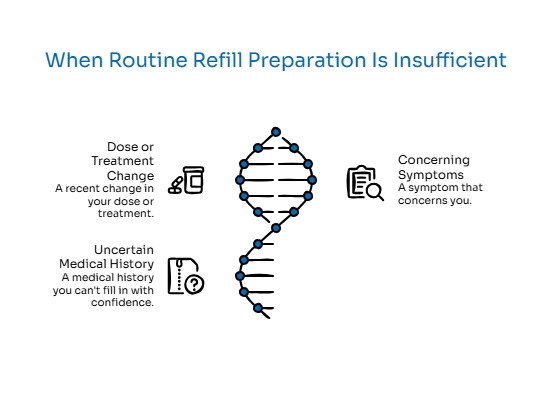
Routine preparation works well when your treatment and health are steady. It stops being enough when something important has shifted.
Three situations call for more than a standard renewal:
-
A recent change in your dose or treatment.
-
A symptom that concerns you.
-
A medical history you can’t fill in with confidence.
In each case, routine renewal assumptions fail because a clinician needs to assess you individually rather than confirm a continuing plan. The guide to signs a refill request may need more than routine review explains why some requests are redirected.
Exactly where that line falls is a clinical judgment. No published threshold for symptoms, missed doses or dose changes applies to everyone, so it isn’t something to estimate on your own. The National Institute of Mental Health makes the same point in its health information, encouraging readers to take personal treatment questions to a qualified health care provider. If anything has changed, talk with a qualified healthcare professional before you request a renewal.
Some changes need prompt attention rather than a refill request. MedlinePlus highlights important mental health warnings for fluoxetine, and new or worsening depression, suicidal thoughts or severe agitation call for contacting a healthcare professional promptly. Routine refill services aren’t designed to replace that kind of assessment. If you’ve already missed a dose, ask your prescriber or pharmacist for medication-specific guidance rather than guessing how to make it up.
If you’re in crisis or thinking about harming yourself, call or text 988 to reach the Suicide & Crisis Lifeline, or call 911.
What Happens After Review
A completed review can lead in a few directions. The clinician may text you with follow-up questions first. A question doesn’t mean the request has failed. It usually means something needs reconciling, such as a difference in directions, and if you can’t verify an answer, say so rather than guessing.
If renewal is appropriate, an electronic prescription is sent to the local pharmacy you selected. If more information is needed, the clinician may ask for further assessment. If renewal isn’t appropriate, the clinician may decline and point you back to your regular prescriber. That outcome is a safeguard working as intended, not a failure, and it isn’t a reason to adjust your current treatment on your own. If you are entirely out of medication and begin experiencing withdrawal symptoms, do not wait for a routine appointment. Instead, contact your regular prescriber’s on-call service, ask your local pharmacist if they can provide an emergency short-term supply, or visit an urgent care clinic or emergency room immediately to safely bridge the gap.
Once a prescription is sent, one task remains yours: confirm that it has actually been filled before you make the trip. Refill Genie’s frequently asked questions cover the review and messaging process in more detail.
Then look one step further. Let your regular prescriber know about any prescription issued through another service, so your records stay current. Use the time the renewal bought you to book your next visit. That appointment is where the larger questions about your treatment get answered.
Frequently Asked Questions
Can an established Prozac prescription be renewed online?
It may be. A clinician-reviewed service for established medications can consider a renewal, and the outcome depends on the individual review.
Does a stable Prozac prescription mean the next refill will be approved?
No. Your history is relevant, but a renewal is a new prescribing decision based on your current information.
How early should I request a Prozac refill?
No single lead time fits everyone. Start while you still have a comfortable margin, and ask your clinician or pharmacist about your timing.
Does a clinician’s response mean my medication is ready?
No. A response, an issued prescription and a filled prescription are separate milestones.
Clinical Review Is the Bridge, Not the Finish Line
Go back to that kitchen counter at 6:20 p.m. The bottle still rattles. The trip is still on the calendar.
This time, the evening goes differently. You counted eleven capsules and wrote the number down. You know that a clinician’s text and a filled prescription run on two separate clocks. Your label is photographed, your changes are listed and your prescriber’s next opening is already in your calendar.
You started with uncertainty about whether your supply and schedule could line up. You now understand why a clinician reviews every renewal, what you can prepare and which decisions belong to someone licensed to make them.
That’s the real value of clinician review. It’s what separates an established Prozac renewal from an automatic online transaction. It’s also why Refill Genie describes itself on its About Us page as a temporary bridge, not a replacement for your primary care doctor. A continuity bridge carries you across a gap. Your regular prescriber is still the destination. Established treatment provides the history, and current clinical review decides whether renewal is appropriate.
Count early. Share honestly. Let a clinician decide.
Your Next Step
When you’re ready, explore Refill Genie resources, starting with the company’s existing-Prozac refill information. It shows how clinical review works, so you can plan before your next refill window opens.
Disclaimer: This article provides general information about established Prozac prescription refills for educational purposes. Individual circumstances vary significantly based on factors such as current prescription details, changes in health or treatment, symptoms, medication history, and the information available for clinical review. Decisions about renewal, dosage, missed doses, medication changes and ongoing treatment should be made with a qualified healthcare professional. Seek urgent assistance for severe symptoms or immediate safety concerns.
Our Editorial Process
Our expert team uses AI tools to help organize and structure our initial drafts. Every piece is then extensively rewritten, fact-checked, and enriched with first-hand insights and experiences by expert humans on our Insights Team to ensure accuracy and clarity.
About the Refill Genie Insights Team
By: The Refill Genie Insights Team
The Refill Genie Insights Team is our dedicated engine for synthesizing complex topics into clear, helpful guides. While our content is thoroughly reviewed for clarity and accuracy, it is for informational purposes and should not replace professional advice.