
August 14, 2026
6 Signs an Online Prescription Refill Request May Need More Than Routine Review
📌 Key Takeaways
Online refills need honest, current details because health or treatment changes may require a clinician to review your request closely.
-
Report Every Change: The author recommends reporting new symptoms, side effects, diagnoses, medicines, supplements, allergies, and monitoring results.
-
Check Current Instructions: Compare the bottle label with your latest directions, and explain who changed them and when.
-
Prepare a Short Summary: List what changed, when it changed, and who was involved to reduce avoidable follow-up questions.
-
Extra Review Is Normal: A request for details does not predict denial; it helps the clinician make an informed decision.
-
Know the Service Limits: Online refills may not fit new medicines, acute symptoms, physical exams, or ongoing primary care.
Current facts help clinicians make safer refill decisions.
People requesting existing medications online will prepare stronger submissions by using the six warning signs and readiness checklist below.
You know the medication. You have taken it before. The name on the bottle is the same one you plan to request — so the refill should be straightforward.
Not always. A prescription refill reflects a specific dose, schedule, health history, and set of circumstances that existed when the prescription was written. When any of those details have shifted, the request may need closer consideration.
HHS telehealth preparation guidance recommends gathering current medicines and doses, medical history, symptoms, and questions before a virtual visit. The framework below applies that principle to an online refill request and gives you a preparation checklist you can complete in one sitting.
What “More Than Routine Review” Actually Means
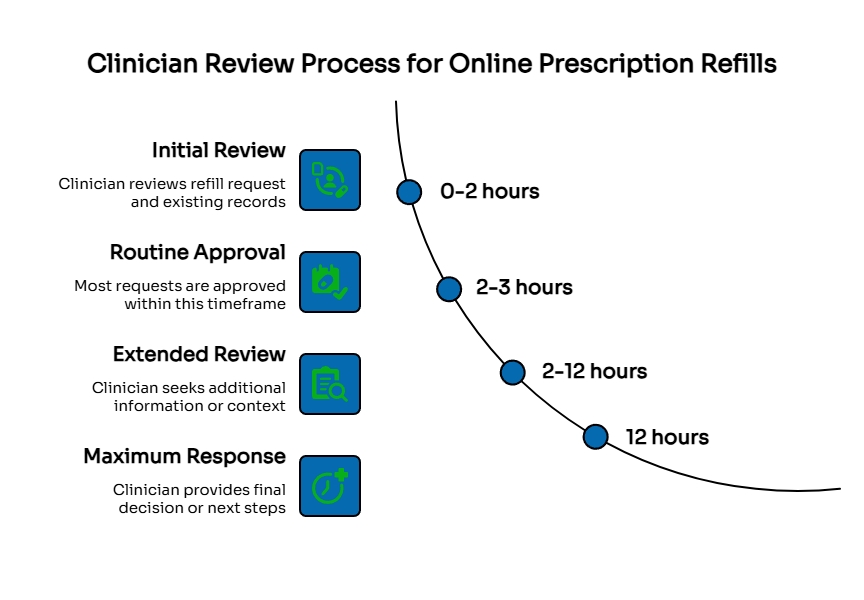
A request that needs more than routine review is not a rejection. It means a clinician may need additional context — a follow-up question, a request for records, a conversation about monitoring, or a recommendation to seek a different type of care. The clinician, not an automated system, determines the next step. Even when additional information is required, a doctor responds within a maximum of 12 hours—and often completes the review within 2 to 3 hours. Responsible review is a safety feature, not an inconvenience, punishment, or barrier. It gives the clinician an opportunity to consider current information instead of treating an online request as automatic.
| When Nothing Has Changed | When Something Has Changed |
|---|---|
| Medication, dose, schedule, and instructions match the existing prescription | Dose, symptoms, medication list, health history, or records have shifted since the prescription was written |
| No new symptoms, side effects, or health-history changes to report | One or more changes may affect whether the current plan remains appropriate |
| The clinician can review using existing information | The clinician may need updated details or records before deciding |
Neither column predicts the outcome. Knowing which starting point applies helps you prepare the right information. And “online” does not mean “automatic” — an online refill pathway still involves a licensed clinician reviewing your health information and making an individualized decision.
Six Signs Your Request May Need Closer Consideration
Each category below describes a situation where your existing prescription may no longer match your current reality. None automatically disqualifies a refill. All give a clinician a reason to look more carefully.
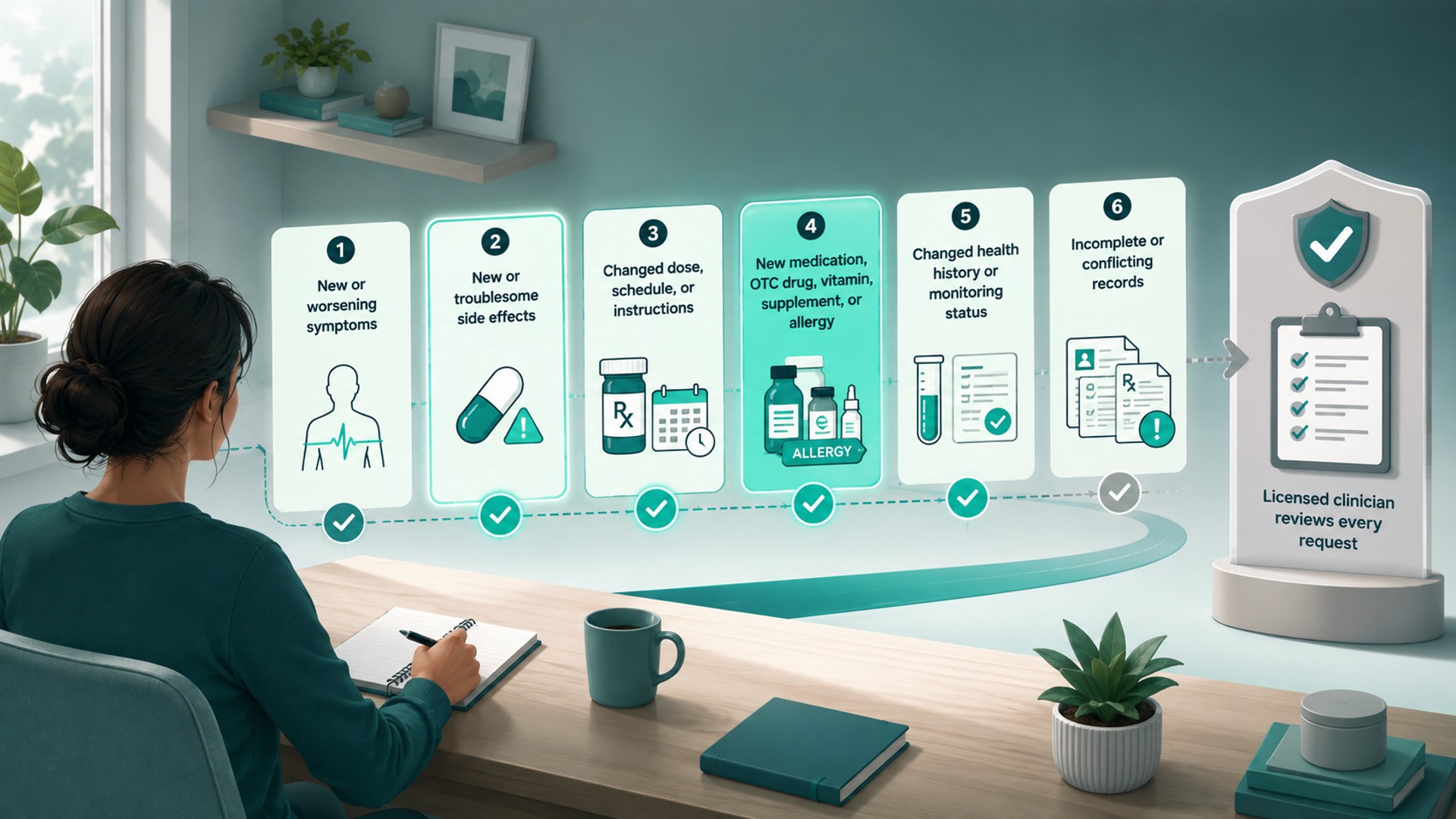
1. New or Worsening Symptoms
A symptom that appeared or worsened after the last prescription was written could affect whether the same treatment plan remains appropriate. Even if the symptom seems unrelated, mentioning it gives the reviewing clinician a fuller picture.
Include when the symptom started, how often it occurs, and whether it has changed over time. A specific observation such as “daily headaches for three weeks” provides more context than “I feel off.”
Do not omit a symptom because you fear that mentioning it will automatically block the refill. The clinician needs complete information to determine whether an existing-medication refill pathway still fits the situation.
2. New or Troublesome Side Effects
An unchanged medication can feel different over time, especially when other parts of your health or medication use have changed. The FDA notes that dose adjustments, stopping another drug, starting a new drug or supplement, and underlying health conditions can all influence side-effect risk.
Report the effect, when you noticed it, and whether it has remained steady or worsened. MedlinePlus advises contacting a provider or pharmacist about side effects rather than independently adjusting treatment.
3. A Changed Dose, Schedule, or Set of Instructions
If a clinician changed your dose or schedule since the existing prescription was written, the bottle label may no longer reflect your current instructions.
For example, imagine a reader whose bottle still displays a twice-daily schedule, but a clinician adjusted the instructions to once daily several months ago. Submitting the request without explaining the change means the reviewing clinician sees only the older information.
Compare the label on your bottle with the most recent instructions you received and note who changed the directions and when. For more detail, see what to check when your dose or schedule has changed.
4. A New Medication, OTC Drug, Vitamin, Supplement, or Allergy
Your current medication list — not just prescriptions — may affect the review. A complete list includes every prescription drug, over-the-counter medicine, vitamin, herbal product, and supplement you take, along with known allergies.
Many people forget to mention an OTC pain reliever, a new vitamin, or a supplement recommended by a friend. Each addition becomes part of the clinical picture.
Healthcare professionals call this medication reconciliation — obtaining, verifying, documenting, and comparing a patient’s medication information to identify discrepancies. AHRQ describes it as a foundational safety practice, and its MATCH Toolkit addresses how this concept applies across care settings and transitions. For a refill request, the practical version is simpler: write down everything you currently take, including items you did not need a prescription to buy.
5. A Change in Health History or Monitoring Status
A new diagnosis, a resolved condition, a hospitalization, or a change in a chronic condition can affect whether an existing prescription remains appropriate. Some medications may require periodic laboratory monitoring, and the clinician may need to know when the last relevant test occurred and what the results showed.
If monitoring was performed at a different facility, those results may not be available during review. Locating them beforehand — or noting that you do not have them — reduces avoidable follow-up questions. Do not assume that older results remain sufficient or that every medication requires the same tests or schedule; those decisions are medication- and patient-specific.
6. Incomplete, Conflicting, or Mismatched Records
Sometimes the issue is a collection of mismatched details. Multiple prescribers, multiple pharmacies, a recent move, or a gap in care can leave records fragmented.
When records conflict, report what you have and identify where each version came from. Let the clinician determine which record reflects the correct treatment plan. If your request no longer fits within the boundaries of an existing-medication renewal — for instance, if you are requesting a medication change rather than continuing a current prescription — a different care pathway may be more appropriate.
Here is a quick-reference summary of all six signs:
| Sign | Key Information to Gather | Why Follow-Up May Occur |
|---|---|---|
| New or worsening symptoms | Onset, frequency, severity, patterns | May affect whether the current plan is appropriate |
| New or troublesome side effects | Which effect, onset, stability, concurrent medication changes | Risk can shift when other health variables change |
| Changed dose, schedule, or instructions | Bottle label, most recent instructions, who changed them, when | Conflicting records may need clarification |
| New medication, OTC drug, vitamin, supplement, or allergy | Complete current list including non-prescription items and allergies | May reveal interactions or duplications |
| Changed health history or monitoring status | New diagnoses, resolved conditions, procedures, recent lab results with dates | May affect whether the existing prescription is still suitable |
| Incomplete or conflicting records | All versions, sources, prescriber or pharmacy details | Mismatched records need clinician review |
Use the Refill Review Readiness Check
Work through each applicable row and use the results to write a brief “what changed?” summary before submitting. Include the medication name, strength, and current directions; who changed the instructions and when; new symptoms or side effects; additions to your medication list; relevant health-history changes; available lab results and pharmacy details; and questions for the clinician.
For a detailed walkthrough, see records to gather before requesting an online refill. If you manage several medications, keeping refill information organized in one place makes this easier.
| What Changed? | What Information Should I Gather? | Why Might a Clinician Ask Follow-Up Questions? | What Should I Avoid Assuming or Doing? |
|---|---|---|---|
| New or worsening symptoms | Onset, frequency, severity, and any pattern | May affect whether the current medication and dose remain appropriate | Do not assume the symptom is unrelated or that mentioning it causes denial |
| New or troublesome side effects | Which effect, when it began, stability, and concurrent medication changes | Side-effect risk can shift when other health variables change | Do not independently stop or adjust the medication without professional guidance |
| Changed dose, schedule, or instructions | Bottle label, most recent instructions, who changed them, when | Conflicting records may need clarification | Do not assume the bottle label is always current |
| New medication, OTC drug, vitamin, supplement, or allergy | Complete current list including non-prescription items and new allergies | The full list may reveal interactions or duplications | Do not report only prescription medications |
| Changed health history or monitoring status | New diagnoses, resolved conditions, procedures, recent lab results with dates | May affect whether the existing plan is still suitable | Do not assume prior lab results remain valid indefinitely |
| Incomplete or conflicting records | All versions, where each came from, which prescriber or pharmacy provided it | Mismatched records need clinician review | Do not resolve the discrepancy yourself |
Imagine opening the refill form during a busy workday and being pulled into a meeting before finishing. Without a prepared summary, you may rush through follow-up questions or submit incomplete answers later. A few minutes of preparation beforehand means the information is ready whenever you return.
If you are helping a family member, you can organize medication labels, dates, records, prescriber and pharmacy details, and questions ahead of time. Let that person describe symptoms and side effects and participate in clinical decisions rather than answering or deciding on their behalf.
A completed summary does not guarantee approval or denial. More documentation does not ensure a particular outcome, and a request for clarification does not equal denial. Additional review is part of the clinical process, not a predetermined result. Do not start, stop, or change your medication while waiting for a response — contact a licensed healthcare professional if you have concerns about your current treatment.
What May Happen After You Disclose a Change
A clinician may respond in several ways: moving forward with a refill if clinically appropriate, asking a clarifying question, requesting additional records, recommending monitoring, suggesting a conversation with your primary care provider, or directing you toward an in-person visit, emergency care, or another suitable setting.
None of these responses is a punishment for honest disclosure. Each reflects clinical judgment applied to the information you provided. Incomplete information limits what the clinician can evaluate — and may lead to more questions, not fewer.
When an Online Refill Pathway May Not Fit
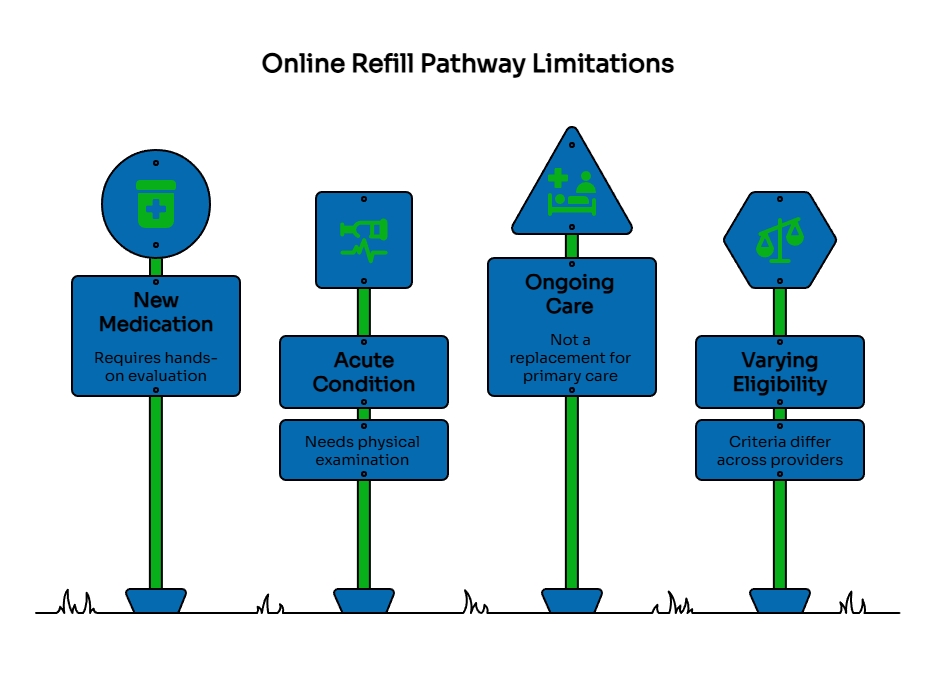
An online existing-medication refill is designed for a specific situation: continuing a medication that has already been prescribed, at an established dose and schedule, for a patient whose circumstances have not changed in ways that require hands-on evaluation.
Some situations fall outside that scope: starting a new medication, acute-condition diagnosis, symptoms requiring physical examination, or ongoing primary care management. RefillGenie, for example, states that it does not start new medications or diagnose acute conditions and describes its service as temporary bridge care rather than a replacement for ongoing primary care. You can learn more about how RefillGenie reviews existing-medication refill requests.
Service scope and eligibility can vary across providers. Read the provider’s current criteria and give the clinician complete information instead of trying to classify the request on your own.
If you believe you may be experiencing a medical emergency, call 911 or seek emergency care.
Prepare the Facts, Then Let the Clinician Decide
The most useful step before submitting a refill request is accurately reporting what has changed. Gather your current medication list, note any new symptoms or side effects, locate your most recent records, and write a short summary covering what is different, when it changed, and who was involved.
Supplying this context upfront empowers the clinician to evaluate your request safely and efficiently, ensuring their decision is grounded in a complete understanding of your current health.
If your situation involves an existing medication and you would like to see whether an online refill may be an option, you can check whether your medication is eligible for review.
Frequently Asked Questions
Does additional review mean my refill will be denied?
No automatic conclusion can be drawn. A clinician may need clarification, documentation, monitoring information, or a different care pathway before making a decision. A follow-up question is part of the evaluation process, not a predetermined outcome.
Should I report a side effect even if I have taken the medication for a long time?
Yes. The FDA notes that side-effect risk can be influenced by changes in dose, other medications, supplements, and underlying health conditions. Report new or worsening effects to a licensed healthcare professional rather than independently adjusting treatment.
What if my bottle label does not match my current instructions?
Report both versions. Note which instructions came from which source, who changed the directions, and when. A clinician or pharmacist can help determine which record reflects the correct treatment plan. For more detail, see what to check when your dose or schedule has changed.
Can an online refill service replace regular primary care?
RefillGenie describes its service as temporary bridge support for existing medications, not a replacement for ongoing primary care. Other services may define their scope differently. If you need regular examinations, long-term condition management, or new-treatment evaluation, reconnecting with a primary care provider is important.
Disclaimer: This article is for general educational purposes only and is not a substitute for personalized medical advice, diagnosis, or treatment. A licensed healthcare professional must determine whether a prescription refill is appropriate. Do not start, stop, or change medication without professional guidance. If you believe you may be experiencing a medical emergency, call 911 or seek emergency care.
Our Editorial Process:
Our content is developed to help readers understand common refill-gap situations, online refill boundaries, and temporary bridge-care options in plain language. We use Refill Genie source materials, service pages, FAQs, customer-feedback patterns, and relevant external authority sources to guide factual accuracy. Health-related content should be reviewed for clinical accuracy, eligibility language, safety limits, pricing, timing, and commercial terms before publication.
About the Refill Genie Insights Team
The Refill Genie Insights Team is our dedicated engine for synthesizing complex topics into clear, helpful guides. While our content is thoroughly reviewed for clarity and accuracy, it is for informational purposes and should not replace professional advice.